To Be or Not to Be a Terrorist, That Is the Question
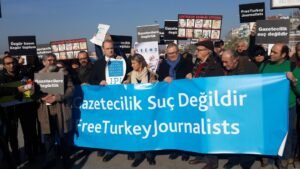
Is it possible in a country to be declared a terrorist, a traitor or a patriot with a few sentences? The author questions polarisation through the labels pinned on artists and journalists.

Topic
Commentary and analysis on politics, polarisation, the media and social change.
Is it possible in a country to be declared a terrorist, a traitor or a patriot with a few sentences? The author questions polarisation through the labels pinned on artists and journalists.
We are a society that can stay estranged from relatives for years. The author asks how the same grudge is reflected in the state’s foreign policy and domestic politics, and how the “land of peace” produces its own enemies.
Has ASELSAN been sold, will military land be sold? The author criticises “political trading” in a political order where even the state’s most vital institutions can become the subject of bargaining.
A podcast episode on the triangular relationship between Greece, the US and Türkiye.
The fire that broke out in the Reichstag building on 27 February 1933 opened Hitler’s path to absolute power. The third part of the self-coup series tells the most famous example in history.
King Cleomenes III of Sparta moved against the institutions of his own state to make his power absolute. The second part of the self-coup series tells the first known example in history.
The claim that a jihadist organisation has been “finished” is misleading, because members and ideology move on to other organisations. The article questions the relationship between jihadism and political Islam.
Young men who harm themselves to avoid military service, people who burn their property to collect insurance… Can states take a similar path? The first part of the self-coup series.
Beyond the ban debates in Europe, the Grey Wolves have officially been considered a terrorist organisation in some Central Asian countries for a quarter of a century. The fifth part of the Ülkücü series.
From an adviser who uses cocaine to a police officer dealing drugs, one scandal after another is coming out. The author argues that these revelations stem not from investigative journalism but from the powerful’s “nothing will happen to me” attitude.
In 2021 the European Parliament called for a ban on the Ülkücü movement in EU countries to be examined. The fourth part of the Ülkücü series looks at the stance in Europe and the US.
In Europe, far-right ideologies are increasingly seen as a growing security threat. The third part of the Ülkücü series looks at Ülkücü organisation in Germany and how German security agencies view it.
Uğur Mumcu was killed in a bomb attack in 1993, and the case has still not been fully solved. The second part of the Ülkücü series examines the Mumcu assassination and the claims surrounding Turgut Özal.
They were banned in Austria and France, the European Parliament raised the idea of a terror listing, and the US Congress called for an inquiry. Why does the world fear the Ülkücüs? The first part of the Ülkücü series.
Love of the homeland is more than attending martyrs' funerals or competing over crowd size at rallies. The fourth part of the Collective Consciousness series looks at how values are wrongly coded into minds.
Topics
Latest articles