
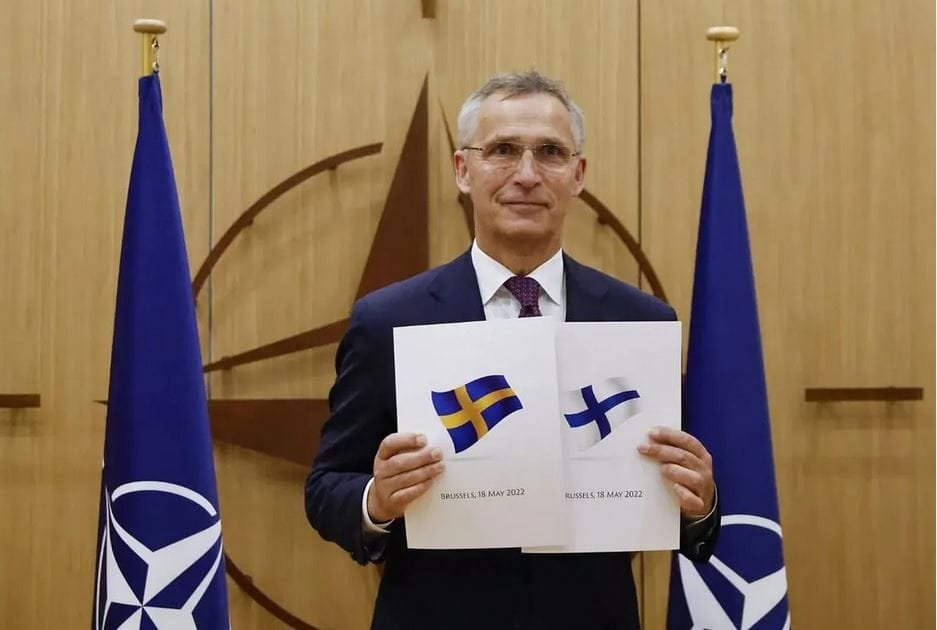
Russia’s invasion of Ukraine ended decades of neutrality: Finland and Sweden applied to join NATO. Prolonged by objections from Turkey and Hungary, the process was completed in 2024.
Growing Insecurity
When Russia attacked Ukraine on 24 February 2022, many countries, above all in Europe, began to feel less secure than before.
Finland and Sweden, both geographically close to Russia, applied to join NATO despite their long-standing neutrality, as insecurity in the region grew and the threat stood right on their doorstep.
An Expanding NATO
NATO, headquartered in Brussels, the Belgian capital, began to enlarge in 1952 with the accession of Turkey and Greece.
Enlargement continued with (West) Germany in 1955, Spain in 1982, the Czech Republic, Hungary and Poland in 1999, Bulgaria, Estonia, Latvia, Lithuania, Romania, Slovakia and Slovenia in 2004, Albania and Croatia in 2009, Montenegro in 2017 and North Macedonia in 2020.[1]
The Strategic Position of Finland and Sweden
Finland shares a long border of some 1,300 kilometres with Russia.
Sweden, in turn, borders Finland.
Both countries are also EU members, and their strategic position right on the Baltic Sea makes them critically important for Russia.
Under the influence of this tense atmosphere, both countries applied for NATO membership in May 2022, about three months after Russia’s invasion of Ukraine.
Putin’s Concerns
Russia, which regarded Finland’s accession process as a mistake from the outset, opposed NATO membership not only for Finland but for all the Nordic countries.
Russian President Vladimir Putin warned that Finland’s accession to NATO would “damage long-standing relations of good neighbourliness and friendship”.
Accession would not only harm neighbourly relations with Russia but would also extend NATO’s borders up to Russia’s own, which Russia regards as an intolerable threat; after all, one of the reasons Russia invaded Ukraine is that the country lies on NATO’s border.[2]
The 2022 NATO Summit in Madrid
At the NATO summit held in Madrid in June 2022, Finland and Sweden were formally invited to join, and the accession protocols were signed on 5 July 2022; even so, the accession process was delayed.
At that summit the Turkish government did not give the memberships an immediate green light, voicing concerns in particular about terrorist activities in Sweden and restrictions on arms exports to Turkey.
Erdoğan: “We Cannot Say ‘Yes’!”
Stating that Sweden and Finland had not addressed Turkey’s concerns on counter-terrorism, Erdoğan said: “They have expectations, but not only have they failed to take the steps they need to take regarding Turkey; even while we were holding these talks, they, Sweden in particular, are still parading terrorists through the streets of Stockholm and protecting them with their own police. On the very evening of the day they held the talks, they even had the terrorist named Salih Müslim speak on Swedish state television, doing every kind of wrong to us, and on the F-16 issue and so on they continue their negative attitude and approach. They are not honest, they are not sincere.”
Erdoğan also said: “As long as Tayyip Erdoğan is at the head of the Republic of Turkey, we definitely cannot say ‘yes’ to countries that support terrorism joining NATO.”[3]
The Ratification Process
About a month and a half after the agreement in Madrid, 23 countries had swiftly ratified the accessions. The other countries then followed.
Hungary and Turkey, however, did not ratify right away. Hungary and Turkey both ratified Finland’s membership in March 2023; Sweden’s was ratified by Turkey in January 2024 and by Hungary in February 2024.
Hungary’s Delayed Ratification
At a meeting with the heads of government of Slovakia, Poland and the Czech Republic, Hungarian Prime Minister Viktor Orbán announced that Hungary intended to ratify Sweden’s and Finland’s accession to NATO.
The Orbán government submitted the draft ratification law to parliament weeks earlier. Parliament, however, did not put it on the agenda right away.
Hungary ratified Finland’s membership in March 2023 and Sweden’s in February 2024.
Erdoğan’s Threats
Erdoğan, for his part, repeatedly threatened to block the accession process if Finland and Sweden did not accept his demands.
He asked both countries to hand over to Turkey people he described as terrorists.
Negotiations
In November 2022 Swedish Prime Minister Ulf Kristersson went to Ankara but failed to obtain Erdoğan’s firm approval for NATO membership.
Shortly afterwards Finnish Defence Minister Antti Kaikkonen likewise came away from a visit to Ankara without approval.
NATO Secretary General Jens Stoltenberg then stepped in. During this process he travelled to Turkey several times to persuade Erdoğan and stated that the two countries had made enough effort to address the concerns.
Stoltenberg’s efforts, however, did not bear fruit immediately either. Turkey’s then foreign minister Çavuşoğlu said that the timing of Finland’s and Sweden’s admission would depend on when Turkey’s demands, agreed in a joint memorandum, were met.
Erdoğan’s Approval
In early 2023 Erdoğan was persuaded to accept Finland’s accession to NATO, and he approved it in March 2023.
Sweden’s case, however, was not like Finland’s, and another year would have to pass for Sweden.
In January 2024 the Grand National Assembly of Turkey ratified Sweden’s NATO membership, and Erdoğan signed it into law; immediately afterwards, the US administration approved the sale of F-16 fighter jets to Turkey and notified Congress.
We do not know exactly what happened as Erdoğan was being persuaded. Despite his statement that “as long as Tayyip Erdoğan is at the head of the Republic of Turkey, we definitely cannot say ‘yes’ to countries that support terrorism joining NATO”, he gave his approval in the end. Time will have to pass before we understand what went on behind the scenes.
A Happy Ending
In the end it took almost two years for all NATO member states to ratify the accession of Finland and Sweden. Finland became an official NATO member on 4 April 2023, Sweden on 7 March 2024.
The regional insecurity heightened by Russia’s attack on Ukraine pushed Finland and Sweden to reconsider their policies of neutrality and apply to join NATO.
The process was not easy, however. Turkey’s concerns and demands, such as tougher counter-terrorism laws, delayed and complicated accession.
Although the NATO Secretary General stepped into the negotiations, the disagreements went unresolved for a long time.
In the end, with the approval of all NATO member states, Finland and Sweden became official NATO members. This long and difficult journey was an important step towards strengthening security and ensuring stability in the region.
Sources
- dergipark.org.tr dergipark.org.tr
- indyturk.com indyturk.com
- Jürgen Fischer, „Der lange Weg in die NATO“, Europäische Sicherheit & Technik, 4/2024, p. 16.
- NATO – Enlargement nato.int
The views expressed in this article are the author’s own and do not necessarily reflect PUGAT’s institutional position. Editorial Principles
Monthly · free
Compass of the Month
PUGAT’s monthly newsletter.
Read next



What is PUGAT? A non-profit community publishing independent analysis from Europe on security, migration and society in Turkish, German and English.
Go to the homepage