
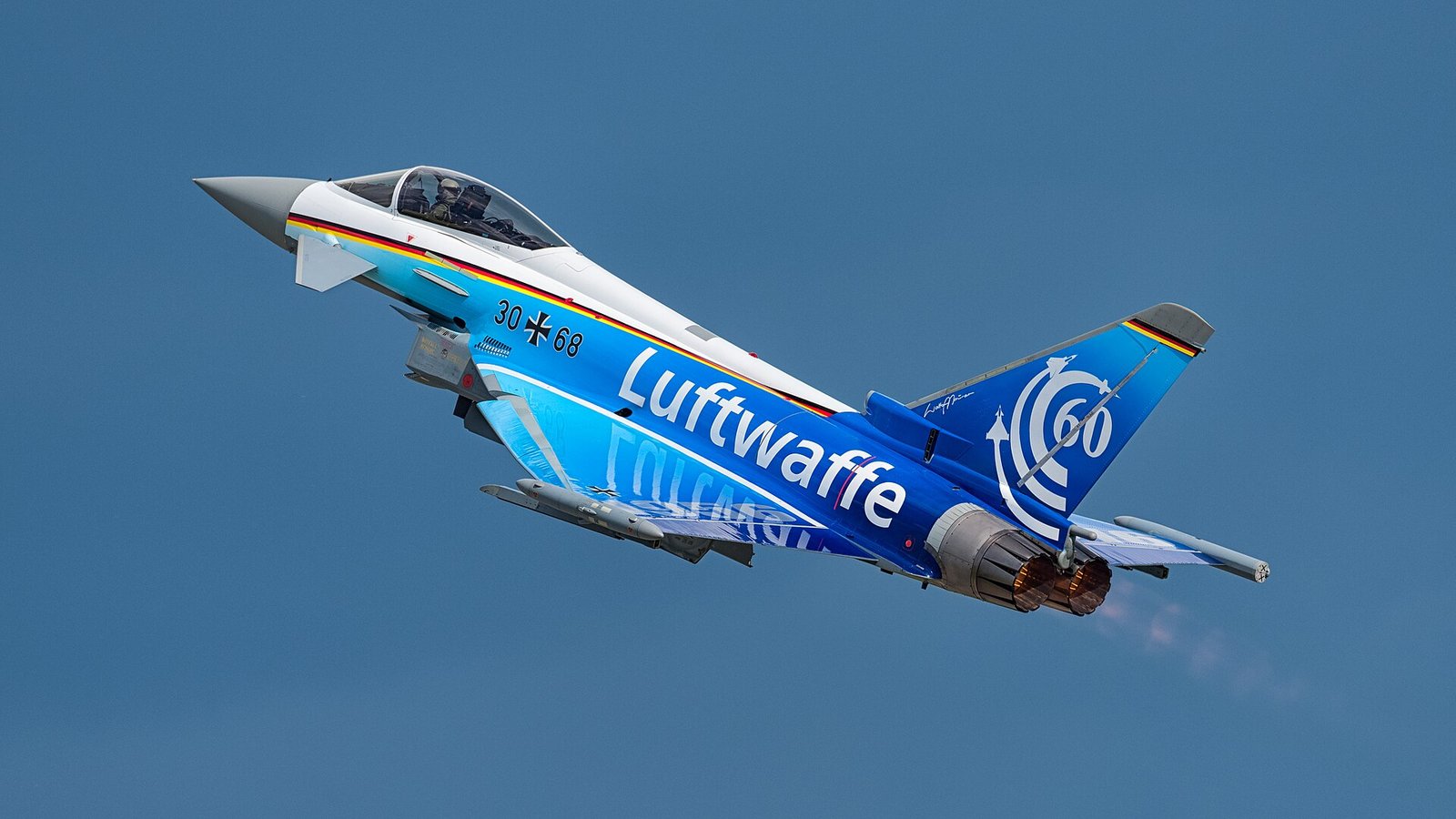
For years Germany kept its distance from selling Eurofighters to Turkey; in the end it gave its approval. The decision points to a pragmatic turn in a European security balance changed by the Russia–Ukraine war.
Germany had long kept its distance from the sale of Eurofighter Typhoon fighter jets to Turkey. However, the fact that the sale has now been approved following recent developments has raised questions about the sincerity of Germany’s strategic relations with Turkey. (i) Update: Germany formally approved the sale in July 2025, and on 27 October 2025 Turkey and the United Kingdom signed an agreement worth about £8 billion for 20 Eurofighter Typhoons.
Rather than meaning that Germany has ignored its existing concerns about Turkey, this decision shows that it has turned to a pragmatic policy change in the light of geopolitical necessities.
Shaped within the framework of the NATO alliance and regional security dynamics, this approval indicates that Germany has adopted an approach that supports Turkey taking on a stronger role in regional security.
The Historical Development of Events and Germany’s Concerns
While Turkey has long been regarded as an ally of strategic importance in Europe and NATO, the moves Turkey has made in its foreign and security policy, especially in the last decade, have increased the concerns of Germany and other European countries.
Arms Sales Had Been Restricted
The German government allowed extensive arms exports to Turkey until the coup attempt of 2016. After the coup attempt and the Turkish military operations in Syria, however, arms exports to Turkey were significantly restricted and a “covert embargo” began to be applied. (i)
Turkey’s stance on security policy, out of step with NATO, led Germany to limit its arms sales to Turkey. Because of the possibility of military equipment being misused in Turkey’s operations in northern Syria, Germany had kept its distance from the sale out of concern that advanced weapons such as the Eurofighter could be used in such operations.
Moreover, Turkey’s purchase of S-400 air defence systems from Russia in 2019 was another factor reinforcing Germany’s security and compatibility concerns. Germany and other allies opposed this move on the grounds that it could threaten NATO. Germany had also avoided arms sales because of human rights violations and restrictions on freedom of expression in Turkey.
Despite this background and the fact that the concerns have not disappeared, Germany has now taken a flexible stance in line with Turkey’s geopolitical position and Europe’s security interests and chosen to approve the Eurofighter sale.
Possible Explanations and Reasons for the Change of Strategy
Germany’s decision points to three main possibilities:
- Turkey’s Growing Importance in NATO and the European Security Balance:
It can be assumed that concerns created by the fact that the Russia–Ukraine war has not yet ended played a role in Germany’s approval of this arms sale to Turkey. The prolongation of the war may have raised fears that Russia could further increase its military and political influence in the region. Turkey’s development of economic and strategic cooperation with Russia in recent years is being closely watched by Germany and other NATO countries. This rapprochement means that Russia could gain more influence in the Middle East and the Mediterranean through Turkey.
In this context, it can be said that Germany’s effort to strengthen relations by providing strategic support to Turkey is intended to limit Russia’s influence in the region and to encourage Turkey to remain in a position closer to NATO.
- Germany’s Turn to Strategic Flexibility in Relations with Turkey:
It appears that Germany continues to hold its earlier concerns about Turkey but approaches them with strategic flexibility in the light of current conditions. Germany may have given the green light to such military sales so that Turkey can play a balancing role in the Middle East and the Eastern Mediterranean. For Germany, Turkey remaining in the Western alliance may have become a higher security priority than its drifting towards the eastern market.
- Economic and Geostrategic Necessities:
Germany’s aim of benefiting economically and strategically from a large market such as Turkey can also be linked to the economic crisis the country is in. In recent years Germany has faced serious economic difficulties such as fluctuations in energy prices and slowing economic growth. This has made Germany’s need to increase defence industry exports and to support its economy through strategic partnerships more pronounced.
The commercial opportunities that could arise from military and technological cooperation with Turkey can be seen as an opportunity for the German economy. By expanding its own defence industry, Germany may aim both to create jobs and to protect its long-term economic interests in the Turkish market. Such defence industry partnerships could strengthen Germany’s NATO alliance and also give momentum to its efforts at economic recovery.
Conclusion
Germany’s approval of the Eurofighter sale to Turkey does not mean that it has left its earlier concerns completely behind.
This decision shows that Germany, in line with its strategic interests, has adopted a more pragmatic approach that takes Turkey’s geopolitical role into account.
This step shows that flexibility and strategic interests are at the forefront of Germany’s foreign policy and that it adapts its policies to geopolitical conditions.
Sources
The views expressed in this article are the author’s own and do not necessarily reflect PUGAT’s institutional position. Editorial Principles
Monthly · free
Compass of the Month
PUGAT’s monthly newsletter.
Read next


What is PUGAT? A non-profit community publishing independent analysis from Europe on security, migration and society in Turkish, German and English.
Go to the homepage