

Before the 2023 elections people were asking: “What happens if Erdoğan loses?” Drawing a striking parallel with the 2012 Venezuelan election, the author discusses scenarios of violence and chaos.
As the presidential election of 14 May approaches, part of society fears that the Palace will resort to violence if Kemal Kılıçdaroğlu comes first and wins despite every kind of fraud.
Although the AKP denies it, the opposition base that has borne the brunt of AKP rule has long been saying aloud that Erdoğan may refuse to leave if he loses.
In the latest polls there is no visible break in the AKP’s core base. Echoing the language of senior AKP figures, the base believes that in the run-up to the election the Islam-hating opposition wants to wear Erdoğan down with intense propaganda.
As Turkey heads into the most important election in its history, Erdoğan, apparently healthy and the “Reis” of those who believe in him, is preparing for the final blow. For the first time, six opposition parties have united behind a single candidate.
In a tense election atmosphere, in a divided society where illegal arming is growing, impunity reigns and organised crime groups are springing up like mushrooms, the unrest in the streets carries risks that make every kind of scenario possible.
***
The sentences above, which I chose to introduce this article, are facts known to every dissenter from every walk of life who follows the country’s agenda even a little. So why did I put them at the start in bold italics? Why did I think this introduction would make you read on? Because this text was taken from a news report published two months before the Venezuelan presidential election of 7 October 2012. When the dates and names were changed, the text above emerged.
According to the latest polls, Erdoğan is not reaching a majority large enough to keep the presidential seat. Despite his enormous propaganda power and the state’s countless resources, his support simply does not reach the level he wants because of the deep economic collapse and the recent earthquake disaster. A large group who think they know Erdoğan well also agree that he will not go into an election he is going to lose. So what will Erdoğan do? How will he emerge victorious from an election he is going to lose? Two possibilities have been voiced lately. The first is to rig the election, create a fait accompli through the Supreme Election Council (YSK) and declare victory. The second, which is the subject of this article, is to create a bloody chaos of unknown scale, intimidate the opposition and impose the election results in his favour.
But could Erdoğan go this far, could he really embark on such madness? It is not easy to answer this question fully.
That is why the example of Venezuela, which went through a similar process before Turkey, may allow us to make some assumptions. After leaving prison in 1994, where he had been since 1992, Hugo Chávez was elected president of Venezuela in the 1998 elections, which he contested with the Fifth Republic Movement he founded. In the fourth year of his presidency, on 11 April 2002, he faced a failed coup attempt. In this period, when the people too were split in two, the leading groups supporting Hugo Chávez included a paramilitary structure, the Colectivos . The colectivos, who were in the front line of street clashes in which violence peaked, said at every opportunity that they were the real force that repelled the 2002 coup, and some groups among them even gave these clashes religious meanings.
“We saved the president in 2002” became the catchphrase of the era, the refrain of marches and songs.
After the failed coup against him, Hugo Chávez designed an army intertwined with politics through purges and new appointments. He took officers out of their barracks and appointed them to ministries and cabinet posts. He gave generals wide opportunities to control banks and other financial services. In this period, some of the paramilitary colectivos, which evolved into a fragmented structure under different leaders, played an active role in implementing official aid programmes with government support. In this way they spread among the poor masses. Many former soldiers and police officers served as middle and senior managers within the colectivos. US intelligence reports recorded that these soldiers and police officers had not cut their ties with their former institutions.
In 2013, opponents who mobilised against Nicolás Maduro, who succeeded Chávez after his death, began to press for Maduro to resign and call early elections.
As Maduro resisted the growing pressure, Juan Guaidó, the speaker of the opposition-controlled National Assembly, declared himself interim president. After this move the streets were in turmoil once again, and in addition to the army and police Maduro sent the paramilitary colectivos back into the field, saying “What cannot be done with votes will be done with weapons”. Thousands of weapons were distributed to colectivo members. The manhunt carried out under police protection by organised, quickly mobilised groups with armed training caused splits in the opposition bloc. Maduro managed to keep his seat and crush the opposition.
According to Marcos Ponce, director of the Venezuelan Observatory of Social Conflict, the colectivos’ sphere of influence was very large. In the capital Caracas alone there were between 80 and 100 groups. The press reported that they occupied public spaces, carried out identity checks and controlled schools, hospitals and workplaces.
It was also unclear exactly who these people were, operating mainly in the poorer parts of the city and defending Hugo Chávez’s revolution at any cost. According to Roberto Briceño León, director of the Venezuelan Violence Observatory, the colectivos did the dirty work the army and police did not want to do and, acting as private individuals, went unpunished thanks to their good relations with the state’s judiciary and law enforcement. Today thousands of armed regime fanatics, made up of hundreds of subgroups gathered under the heading of colectivos, are the nightmare of the scattered opposition.
***
Turning from Venezuela to Turkey, less than two months remain until the election. Considering what has happened in Turkey over the last ten years, we can safely say that the Palace is keeping the option “if not through elections, then through chaos” on the table.
Here, from the Venezuelan example, the following question immediately comes to mind. Does the Palace have a paramilitary army? Yes, it does. Remember Kemal Kılıçdaroğlu going to the door of SADAT. In fact, not only the Palace but also the nationalist elements, the ulusalcı (secular-nationalist) wing and the Hizbullah supporters acting with the Palace have armed elements underground.
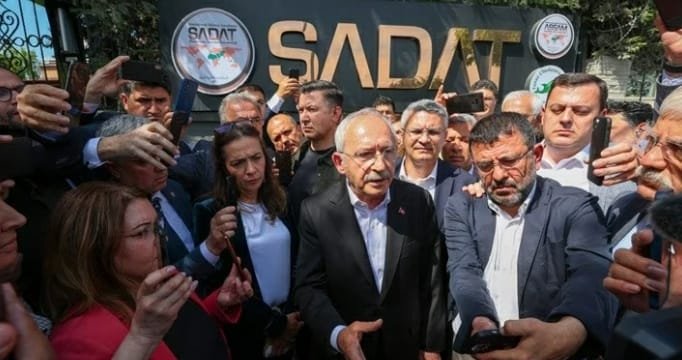
In my view, it is these groups that make the Palace uneasy. Because there is no guarantee that the paramilitary structures (the minds behind them) will act together in a situation of chaos and target the opposition. The Palace does not want to be stabbed in the back during the transition. In this context, one reason Erdoğan insisted on having Kemal Kılıçdaroğlu as his opponent was that he thought the nationalist, ulusalcı and Islamist paramilitary structures allied with him could be consolidated against Kemal Kılıçdaroğlu, who is neither Turkish nor Sunni. Kılıçdaroğlu, from Dersim, a Zaza and an Alevi, was the ideal candidate for propaganda aimed at turning him into an enemy.
***
In Venezuela, Maduro and his partners succeeded in establishing a dictatorship and opened the gates of hell. Of course Turkey is not Venezuela; every country has its own social structure and very different dynamics. But even if the roads to dictatorship differ, they always pass through the same stops. I hope Turkey does not call at that stop. (Update: Erdoğan was re-elected in the run-off of 28 May 2023 with 52.18 per cent of the vote; no violence of the kind discussed in this article followed the election.)
The views expressed in this article are the author’s own and do not necessarily reflect PUGAT’s institutional position. Editorial Principles
Monthly · free
Compass of the Month
PUGAT’s monthly newsletter.
Read next

What is PUGAT? A non-profit community publishing independent analysis from Europe on security, migration and society in Turkish, German and English.
Go to the homepage