
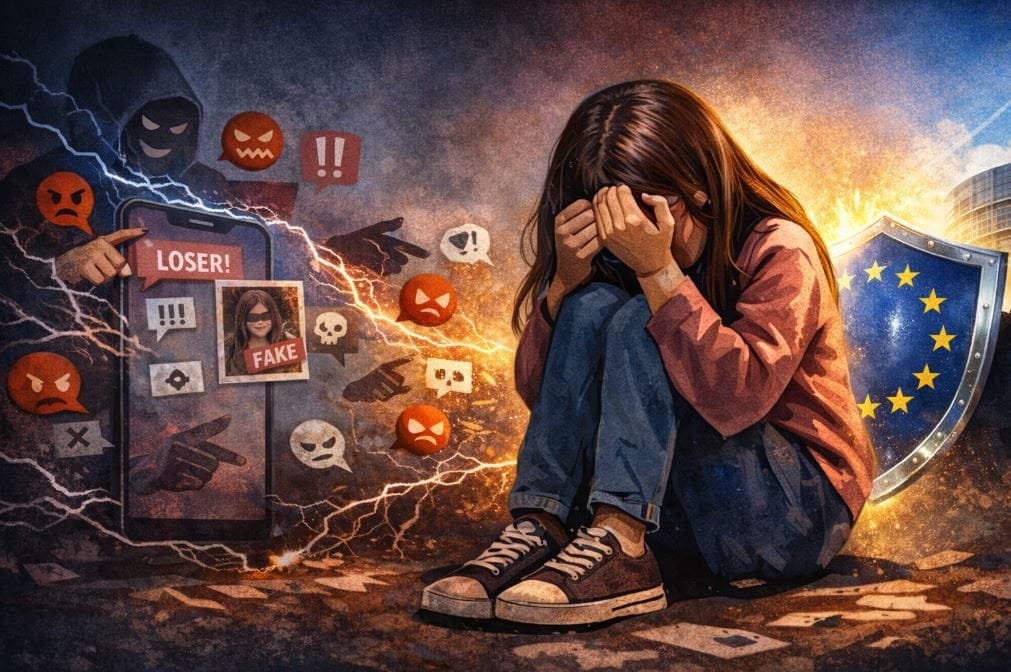
Cyberbullying is no longer a debate about screen time but a public health issue. The EU’s new action plan aims to establish online dignity, privacy and safety as fundamental rights.
In our digitalised world, online hate and cyberbullying now mean much more than a debate about “screen time”. We are facing a multilayered public health issue that wears down a person’s nervous system, sleep patterns and social ties. A comment we scroll past, an organised “mention” attack or manipulated content turns many people, especially children and young people, into victims. And long-term stress, avoidance behaviour and chronic psychological burdens build up in these victims’ minds.
A current illustration of this was the Epstein files, which shook the global agenda in recent weeks. The way the documents were released made visible not only debates about “access to information” but also problems of victims’ privacy, name-hunting, false accusations and online harassment.
In the US, issues such as personal information about victims not being adequately redacted in some of the published Epstein file material, names circulating on social media and some victims being directly harassed online are being hotly debated.
When the line between the “legal process” and the “curiosity of the digital crowd” becomes blurred, a price emerges, and unfortunately it is usually the victims who pay it.
In this context, the European Union’s announcement of a new action plan that addresses cyberbullying within a “digital safety ecosystem” should be seen as a development worth dwelling on. The plan aims to reaffirm dignity, privacy and safety in the digital sphere as fundamental rights.
The Reality in Figures
The scale of cyberbullying as it stands today has grown too wide to be explained by isolated cases. Assessments shared by the European Commission stress that one in six children aged 11 to 15 is affected by cyberbullying.
The EU action plan makes visible the groups in which online victimisation occurs more often. These include, first and foremost, children and young people with disabilities, ethnic and religious minorities, migrants, refugees and LGBT people.

According to the data underlying the action plan, more than nine in ten Europeans consider it “urgent and necessary” for public authorities to take measures to protect children from cyberbullying.
It seems that technological developments are broadening the repertoire of bullying and producing new kinds of harm. Deepfake content produced cheaply with artificial intelligence has a highly destructive effect, especially in sexualised exposure and defamation campaigns. The EU action plan aims to address these risks through more targeted enforcement of existing EU legislation (the DSA and the AI Act). Views that manipulated content produced with AI tools should be labelled and that deceptive uses should be restricted are being taken seriously.
The Anatomy of Cyberbullying
At this point it is worth distinguishing cyberbullying from peer bullying. The most striking feature of cyberbullying is that the attack is independent of time and place. It would not be wrong to say that we are facing a form of bullying that is not confined to school or meeting up with friends and can make even the home unsafe.
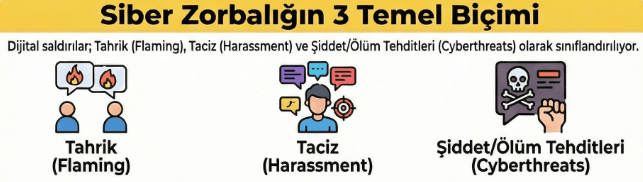
It is worth expanding on the subject in the context of digital violence. In the terminology of digital violence, three forms of attack stand out, which we can call provocation, harassment and cyber threats. With these attacks, deliberate provocations, insults, persistent humiliating messages and rhetoric that extends to threats of violence and death turn victims’ lives upside down.
The blurring of the perpetrator–victim line in the digital environment is also common. Driven by a desire for revenge, a victim may start inflicting a similar or identical form of the pressure they have suffered. It is also common for those who bully to have been bullied in the past, or to struggle with impulsivity or emotional balance.
Indeed, the EU document also stresses that some of those exposed to cyberbullying turn to bullying over time, which is why a child-friendly and careful design of solutions is needed.
A Solution-Oriented Strategy
The EU plan highlights a model in which children can report confidentially, preserve evidence and be quickly referred to the relevant services.
The plan, which stresses that children’s safety online is a right and that cyberbullying violates it, emphasises that reporting must not be “difficult”. Member states need to draw up a swift integration timetable for how and when this approach, formulated as “Reporting should be easier than bullying”, can be put into practice. I hope things are soon reversed in this environment, where causing harm is very easy while stopping harm, gathering evidence and reaching support channels are still very hard.
We must bear in mind that strong public pressure is needed so that ethical rules and courtesy in the digital world are designed, beyond being a matter of choice, as a mandatory standard of social safety and turned into enforceable policies.
So will the EU’s “shield” approach be enough to break the coldness and bullying of the screens? Waiting silently for the measures to be taken does not contribute enough to a solution. Transparent performance indicators and public monitoring that affects platforms’ accountability will speed up this process.
Sources
- European Commission – Shaping Europe’s digital future digital-strategy.ec.europa.eu
- Digital Services Act (DSA) eur-lex.europa.eu
- Artificial Intelligence Act eur-lex.europa.eu
The views expressed in this article are the author’s own and do not necessarily reflect PUGAT’s institutional position. Editorial Principles
Monthly · free
Compass of the Month
PUGAT’s monthly newsletter.
Read next



What is PUGAT? A non-profit community publishing independent analysis from Europe on security, migration and society in Turkish, German and English.
Go to the homepage