
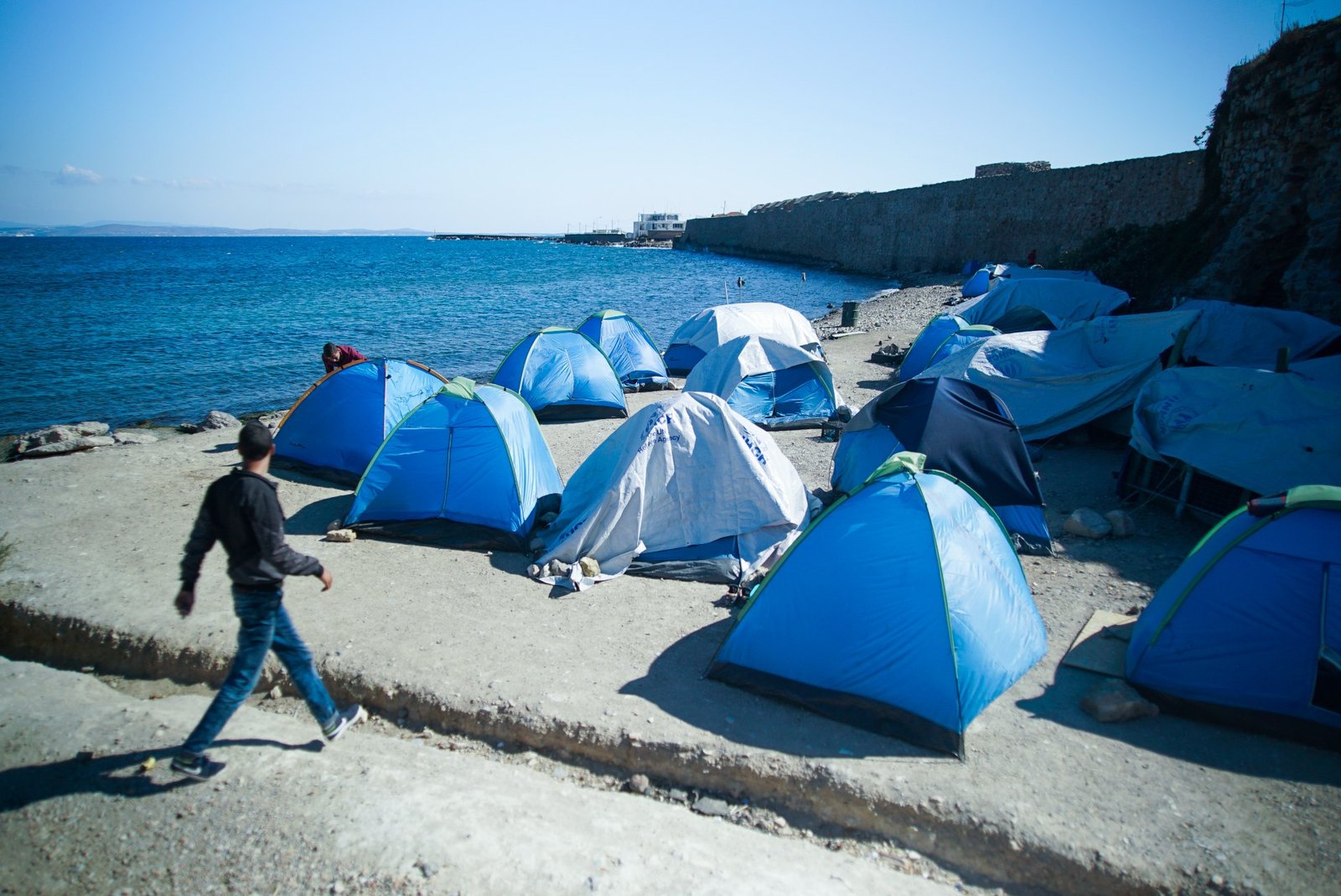
The terms migrant and refugee are often used interchangeably, yet international law draws a clear line between them. Is the Geneva Convention, which protects refugees, enough for those fleeing war and hunger?
Image: Mstyslav Chernov / Wikimedia Commons, CC BY-SA 4.0
After our first article, in which we examined the causes of the mass migration movements in our world and what awaits us in the future, we continue our look at migration by trying to clarify four concepts that are often used wrongly and interchangeably.
The right to free movement within and outside a country is recognised in the Universal Declaration of Human Rights. Article 13 states: “Everyone has the right to freedom of movement and residence within the borders of each State” and “Everyone has the right to leave any country, including his own, and to return to his country.”
However, there is no international instrument that recognises a person’s choice of the country in which they reside as a human right. For this reason every country has the right to regulate crossings of its borders by certain rules and to enforce those rules by law. And everyone is expected to abide by these laws.
At this point I think it is useful to recall the difference between the concepts of refugee and migrant. International law draws a clear distinction between migrants and refugees, because refugee status is a status protected by international law. It is directly linked to universal human rights.
For example, everyone has the right to a life of human dignity. Nobody may be subjected to inhuman or cruel treatment. These and other universal human rights are not guaranteed only, or only recently, by modern law. All religions also recognise these rights and call for their protection. That being so, rulers with a pious appearance who obstruct the right to a dignified life and treat people cruelly have, far from being pious, lost even their humanity.
According to Article 1 of the Geneva Refugee Convention, a refugee is defined as a person who “owing to well-founded fear of being persecuted for reasons of race, religion, nationality, membership of a particular social group or political opinion, is outside the country of his nationality and is unable or, owing to such fear, is unwilling to avail himself of the protection of that country”.
The Geneva Convention Relating to the Status of Refugees, the core instrument of international refugee law, was adopted in response to the political tensions that grew after the Second World War, and it has since helped protect millions of persecuted people.
Given the dramatic rise in the number of refugees worldwide in recent years and the causes of migration, it is clear that this convention alone cannot help everyone in need of protection.
What Determines Refugee Status Under the Geneva Refugee Convention
As we have seen, the Geneva Convention Relating to the Status of Refugees, the core instrument of international refugee law, makes no explicit reference to people fleeing conflict or leaving their country because of hunger. Yet according to the data in question, many of the large refugee movements of recent years were triggered by precisely these causes.
The UN Refugee Agency (UNHCR) also takes the view that people who flee for these reasons and whom their states cannot or will not protect should be considered refugees. Here the decisive factor is whether the person needs international protection. The underlying view is that the protection the person needs does not exist in their country of origin.
To take an extreme example, we could even say that a person whose guilt has been established may, independently of that, need the protection of universal law. In other words, a person accused of a non-political crime, whether guilty or not, may also be persecuted for political or other reasons, and such people convicted for political activities may therefore also obtain refugee status.
In this context it must be stressed that the “principle of non-refoulement” (that is, the prohibition on forcibly returning a person to a country where they are at risk of persecution) is part of customary international law and is therefore binding on every state.
It is possible to extend this protection on humanitarian grounds. Because of climate change, for example, we already see the concept of “climate refugees” being used. But the world is being negligent in taking responsibility for
- Agreeing on a text with universal legal force,
- Defining the concepts of climate refugees and environmental refugees together with their legal consequences,
- Guaranteeing protection for the people affected by this migration, and
- Making the necessary plans.
Who Is a Migrant?
In the United Nations’ statistical classification, international migration is linked to a person changing their country of usual residence for at least three months.
- For stays of three to twelve months the term “temporary migration” is used,
- And for stays of one year or more, “permanent migration”.
People who leave their own countries in the hope of a better life differ from tourists in that they migrate to live elsewhere temporarily or permanently. They should not be blamed simply for wanting a better life, because their residence is granted through a temporary or permanent status (a visa or residence permit) issued by the state concerned. It goes without saying that migrants and refugees must obey the laws of the countries they settle in, and indeed should respect their customs and traditions.
As we can see, migrants do not fall under the international refugee protection system. A migrant usually leaves their homeland voluntarily to improve their living conditions. If they return, they can continue to enjoy the protection of their country. Refugees, by contrast, flee the threat of persecution and cannot return to their countries under present conditions, for example because they are threatened with torture or even death.
Illegal Migrants and Irregular Migrants
The terms illegal migrant and irregular migrant are also often used wrongly, inappropriately and unnecessarily in everyday life.
Since almost all refugees have to enter the countries they arrive in without the necessary passports, visas and other documents, using the term illegal migrant serves no purpose other than to stigmatise refugees and make them a target.
Article 31 of the Geneva Refugee Convention also provides that refugees who meet certain conditions should not be penalised for their illegal entry or presence. The term irregular refugee, too, ought to be used for foreigners present in the country concerned without a valid residence document and unregistered, yet it is mostly used when complaining about the presence of large numbers of migrants or refugees. It is therefore certainly more accurate to speak not of irregular migrants but of migrants in an irregular residence situation. This makes clear that what is irregular or illegal is not the people themselves but their stay in the destination country.
In this respect, the importance of the language used by the media and politicians becomes even clearer. Careless wording or the use of the wrong concepts, knowingly or not, leads to negative perceptions and to faulty law enforcement practices.
We must consider the issue of migration thoroughly from the perspective of the people who migrate as well as the host countries and their people. In this context, we will continue by trying to set out the causes of the hatred directed at foreigners.
Sources
The views expressed in this article are the author’s own and do not necessarily reflect PUGAT’s institutional position. Editorial Principles
Monthly · free
Compass of the Month
PUGAT’s monthly newsletter.
Read next

What is PUGAT? A non-profit community publishing independent analysis from Europe on security, migration and society in Turkish, German and English.
Go to the homepage