
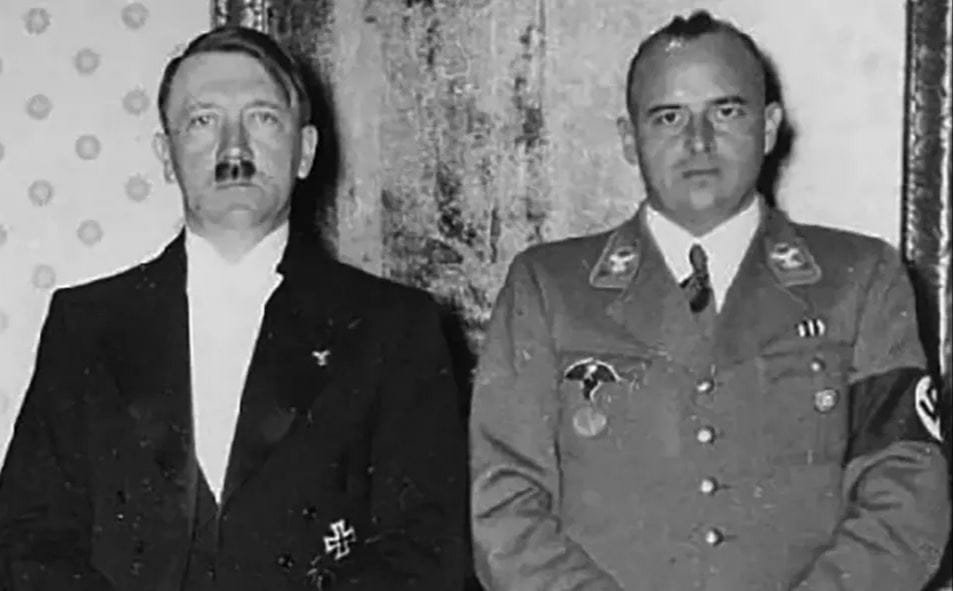
Hitler’s lawyer, governor of occupied Poland, the “Butcher of Poland”. Through his son’s eyes, the story of Hans Frank shows how an educated jurist could turn into a monster within a regime.
“Why do you always carry your father’s photo with you?”
“To make sure he is really dead, and to always remember what kind of zombie’s son I am. In the photo he seems to be smiling as if to say, ‘The vile ideology I followed never died.’”
These words belong to Niklas Frank, son of the jurist(!) Nazi Hans Frank. Hans Frank: Hitler’s lawyer and one of his first accomplices, otherwise known as the Butcher of Poland.
One day a phone call from Hitler opened the years of mastery in Frank’s career and the dark days for Poland. Appointed governor of occupied Poland, Frank took so many lives in so short a time that he proudly compared his own massacres with the killings in Prague, saying:
“In Prague, big red posters were put up on which it was written that seven Czechs had been shot that day. If I wanted to put up a poster for every seven Poles shot, the forests of Poland would not be enough to produce the paper for such posters.”
With his trial as a war criminal and his hanging in 1946, years of shame began for the wife and children he left behind. His son describes him as neither a man of conviction nor a man of principle:
“He had no character and was merely a pragmatist; his only aim was to line his pockets.”
Friends who saw him getting rich fast in the heyday of Hitler’s regime coined a rhyming phrase for him: “Im Westen liegt Frankreich, im Osten wird der Frank reich.” (In the west lies France, the land of the Franks; in the east, our Frank is getting rich.)
That the Butcher of Poland tried to vanish with a small fortune just before he was caught, and said he regretted what he had done just before he was hanged, are memories that never left his family.
After Hans Frank’s death, the children he left behind were always shunned, at school and in social life. Their mother even had to hide their identity. The shame the Frank family lived with for years became a lesson for all through the book published by his son Niklas Frank, who says, “He was my father. My Nazi father. He was a filthy bastard.”
Another question raised by research into him is how an educated lawyer could turn into such a cruel ruler.
According to the historian Christoph Kleßmann, the cause of this transformation into a monster was rivalry within the party. Hans Frank was among those closest to Hitler, that is, tied to the very top, but he had many enemies and envious rivals. Clearly, knowing that he could fall victim at any moment to slander or doubts about his loyalty, he entered an “I am more ruthless” race. After that, a wheel of self-interest and cruelty, each feeding the other, began to turn.
With no political future and always shunned by the party elite, Frank, although he was the party’s chief jurist, was aware of the slippery ground he walked on. That is why the Polish test was the only opportunity for his bloody career.
The motivation that brought out the monster in Hans Frank is in fact the essence of every fascist regime:
“Whoever you are, if you are not an accomplice to the crime, you are in the line of fire. The more ruthless you are, the safer you are.”
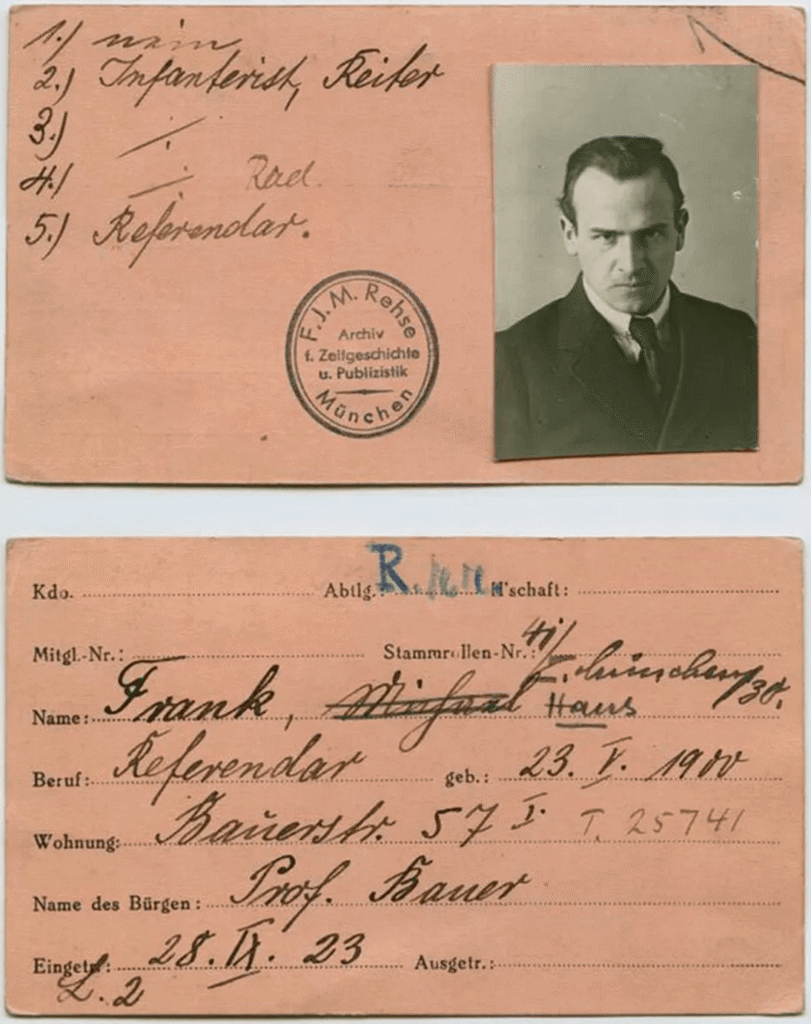
Starting his career by defending poor party members for free, Hans Frank won Hitler’s favour by handling some 150 of his cases and quickly became one of those closest to Hitler, who needed an appearance of legality. Using the law merely as a tool for his political calculations, Hitler, thanks to his ambitious lawyer, manipulated the legal possibilities of democracy to the full.
Nobody was surprised that Hans Frank used religion to cover his sins. Claiming that his service to his country was a form of worship, the Butcher of Poland went even further and could say: “If Jesus appeared today, he would be German. We are God’s instrument for destroying the wicked. We are fighting in God’s name.”
The Butcher of Poland, like everyone else, became a monster for gain, grew rich, tried to flee with whatever he could carry when the regime collapsed, repented when caught, and left behind only a family living in shame and children who hated him.
Like the family of every tyrant, his family wanted to forget their father and make others forget him. Neither the wealth nor the bitter fame he left behind brought them any joy.
This prison of conscience weighed so heavily on the descendants of Hitler’s half-brother from his father’s earlier marriage that, reportedly, they vowed, so to speak, “not to reproduce”.
Victor Hugo says: “The progress of time is the greatest enemy of tyrants.” It cannot be stopped, but living humanely is easy.
Sources
- spiegel.de spiegel.de
- businessinsider.com businessinsider.com
- Christoph Kleßmann, „Der Generalgouverneur Hans Frank“
- youtube.com youtube.com
- youtube.com youtube.com
The views expressed in this article are the author’s own and do not necessarily reflect PUGAT’s institutional position. Editorial Principles
Monthly · free
Compass of the Month
PUGAT’s monthly newsletter.
Read next


What is PUGAT? A non-profit community publishing independent analysis from Europe on security, migration and society in Turkish, German and English.
Go to the homepage