
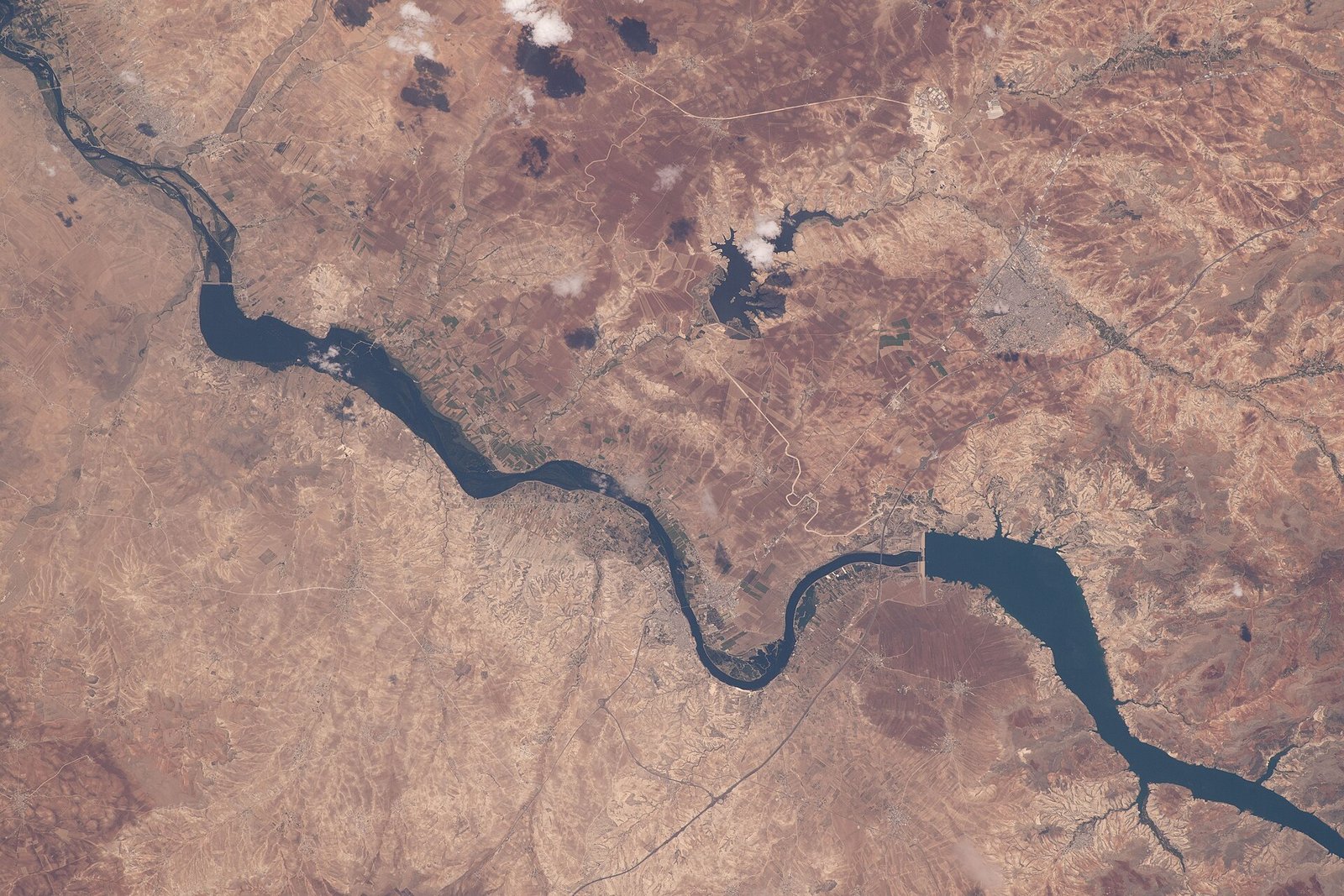
Euphrates Shield, which began with Jarablus in August 2016, was the TSK’s first comprehensive operation against ISIS. The operation ended ISIS’s presence on the border.
Cross-Border Operations in Syria | 3
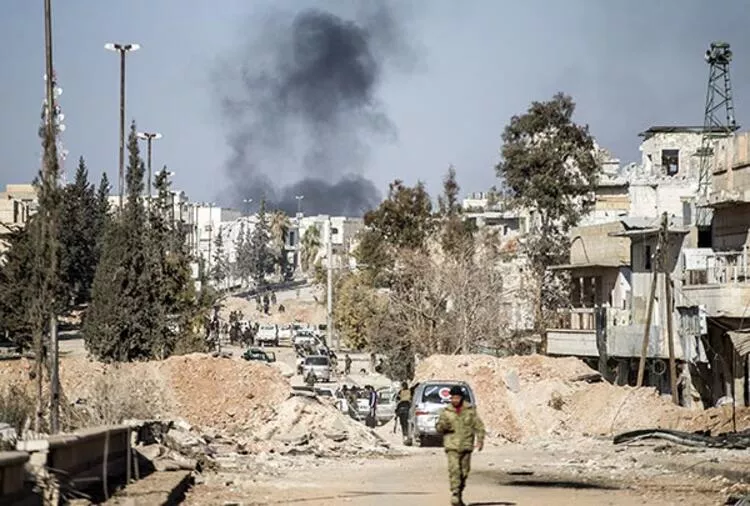
Turkey announced that it had launched a military operation to take Jarablus from ISIS, and after this announcement the Turkish Armed Forces shelled Jarablus. According to a statement from the Prime Ministry, 294 artillery rounds were fired and 81 targets destroyed. Three hours later, a large number of tanks and armoured units of the Turkish Armed Forces crossed the border and joined hundreds of Turkmen and Arab members of the Free Syrian Army (FSA).
On 25 August Turkey struck a YPG group, identified as moving towards Jarablus, with Fırtına howitzers stationed in Karkamış. In a press statement on 26 August the Turkish Armed Forces stated that “Operation Euphrates Shield is continuing, every measure is being taken to ensure that the civilian population living in the region is not harmed, and the utmost care is being shown in this regard”. In addition, the Turkish Armed Forces declared: “The territory will not be annexed; it will be left to the Free Syrian Army.”
On 3 September 2016 Turkish armoured vehicles crossed from the Elbeyli district of Kilis into the Çobanbey district of Syria, and the second phase of the operation began. The Turkish Armed Forces stated that ISIS militants had abandoned their positions and fled. With the offensive on the al-Rai area on 4 September 2016 and the Azaz–Jarablus line coming entirely under the control of the Turkish Armed Forces, ISIS’s presence on the border was brought to an end.
The US and Russia Do Not Want Relations with Turkey to Deteriorate
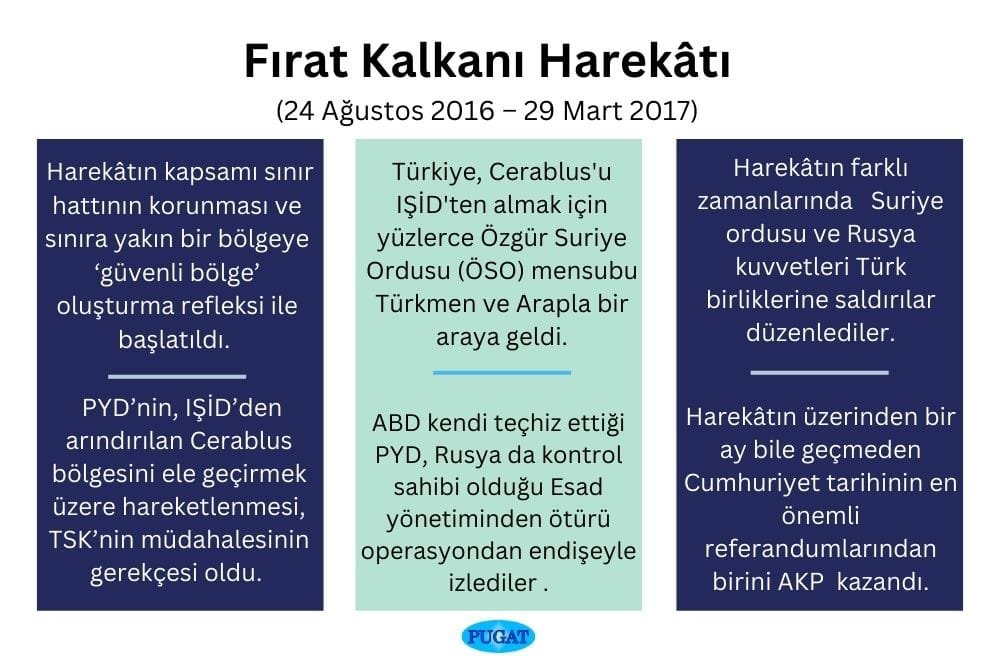
While the US and Russia supported Turkey’s rationale for the operation, they weighed up the balance of gains and losses, even if they were reluctant on some points. The US was certainly not happy about an operation against the PYD, which it had equipped almost entirely. But it chose to support the Turkish Armed Forces in carrying out their first comprehensive operation against ISIS. Russia, in agreement with the Assad administration over which it had control, did not want other countries to become involved in the Syrian civil war. It stressed that if an operation were to be carried out, it should be coordinated and conducted jointly with the Syrian government. Russia, whose relations with Turkey had only just begun to improve, did not want to fall out with Turkey over an operation that did it no harm.
The Operation’s Messages to the Public at Home and Abroad
The timing of the operation is again one of its most striking aspects. Launched about a month after 15 July 2016, the operation carried messages for public opinion both at home and abroad. An operation launched against both ISIS and the PYD terrorist organisations at the same time was perhaps a strategy deliberately chosen to show the strength and capacity of the Turkish Armed Forces. It can be seen as a move against the view that the TSK had lost strength because of dismissals and suspensions and that its hierarchical order had been shaken. However, it is worth noting that thousands of soldiers were suspended or dismissed from the service while the operation was under way and even afterwards. Soldiers serving in the operation zone or behind the front fought the enemy on one side and the fear of losing their careers on the other.
In scope, Operation Euphrates Shield was launched with the reflex of protecting the border line and creating a “safe zone” in an area close to the Turkish border. In particular, the US-backed PYD opening up new areas for itself and trying to establish control over areas vacated by or liberated from ISIS forced the TSK to fight on two fronts. The TSK, which had perhaps aimed to control the region with an operation against a single target without clashing with the PYD, soon found itself forced to fight two enemies at once. Indeed, rapid and effective progress was made when the operation began, and the Jarablus area was cleared of ISIS. At this point the PYD’s move into the area to seize the territory vacated by ISIS made intervention by the TSK unavoidable.
ISIS Returns to “Factory Settings” Against a Regular Army
ISIS forces, which had fought the Iraqi and Syrian armies but had never faced so well-equipped an army, may have believed they could resist this operation with the means at their disposal. But having suffered heavy losses shortly after the operation began, ISIS reverted to its true identity and returned to guerrilla tactics instead of front-line warfare. The fact that, three months into the operation, 40 booby-trapped mines and 1,707 improvised explosive devices had been neutralised shows how delicate the situation was.
The TSK and FSA elements, which first secured the areas they advanced into, were at the same time working to create a safe environment so that civilians could be resettled in the liberated areas and to destroy the booby traps that had been laid. The operation, in which losses were caused more by exploding booby traps and bomb attacks than by fighting, slowed down as a result of the reflex to move in a more controlled manner.
ISIS’s frequent attacks in the areas it had lost made it necessary for the TSK to advance further inland. Clearing ISIS from the al-Bab area, one of the organisation’s important centres of gravity, became unavoidable to prevent attacks. ISIS, which had held the area for a relatively long time, now had to defend an area where it was strong in personnel and equipment. Drawing on the experience gained in the Jarablus area, the TSK shifted to this area personnel well versed in irregular warfare techniques and urban operations. Unfortunately, significant losses were suffered in the area, where fierce fighting took place, particularly in December 2016.
Were Our Soldiers Hit by the Syrian Army or the Russian Army?
Some unexpected, painful events also occurred while the operation was being carried out. The Syrian army and Russian forces, which were not direct counterparts in the operation, attacked Turkish units at different times. It is striking that the attack carried out by the Syrian army took place on 24 November 2016, the anniversary of the day the Russian plane was shot down. Given Russia’s influence over the Syrian government and army, it is obvious that the incident was neither spontaneous nor accidental. On 9 February 2017, this time Russian forces themselves carried out an air strike on a Turkish unit, but declared the strike to have been an accident.
The al-Bab area, completely cleared of ISIS in mid-February 2017, was handed over to the control of FSA units after the booby traps had also been cleared, and efforts were made to enable the civilian population to return. In the press statement issued after the National Security Council meeting held on 29 March 2017, it was announced that the operation had been successfully concluded. From the day the operation began until the day it ended, a total of 72 of our soldiers were killed and hundreds were wounded. Many civilians were also killed and injured. President Erdoğan emphasised that the operation had ended successfully.
An Election Under State-of-Emergency Conditions
The fact that, less than a month after this operation ended in great success(!), one of the most important referendums in the history of the Republic was held, and held under state-of-emergency conditions, played an effective role in the AKP government’s victory. The vote on the Presidential System and the constitutional amendment was held at a time when there was no shortage of news of fallen soldiers and when citizens were afraid to express their views. The AKP government, which put the country into a mood of war and national struggle, made the people accept “one-man” rule thanks to the state-of-emergency administration through which it imposed every kind of climate of oppression.
(To be continued)
The views expressed in this article are the author’s own and do not necessarily reflect PUGAT’s institutional position. Editorial Principles
Monthly · free
Compass of the Month
PUGAT’s monthly newsletter.
Read next
What is PUGAT? A non-profit community publishing independent analysis from Europe on security, migration and society in Turkish, German and English.
Go to the homepage