
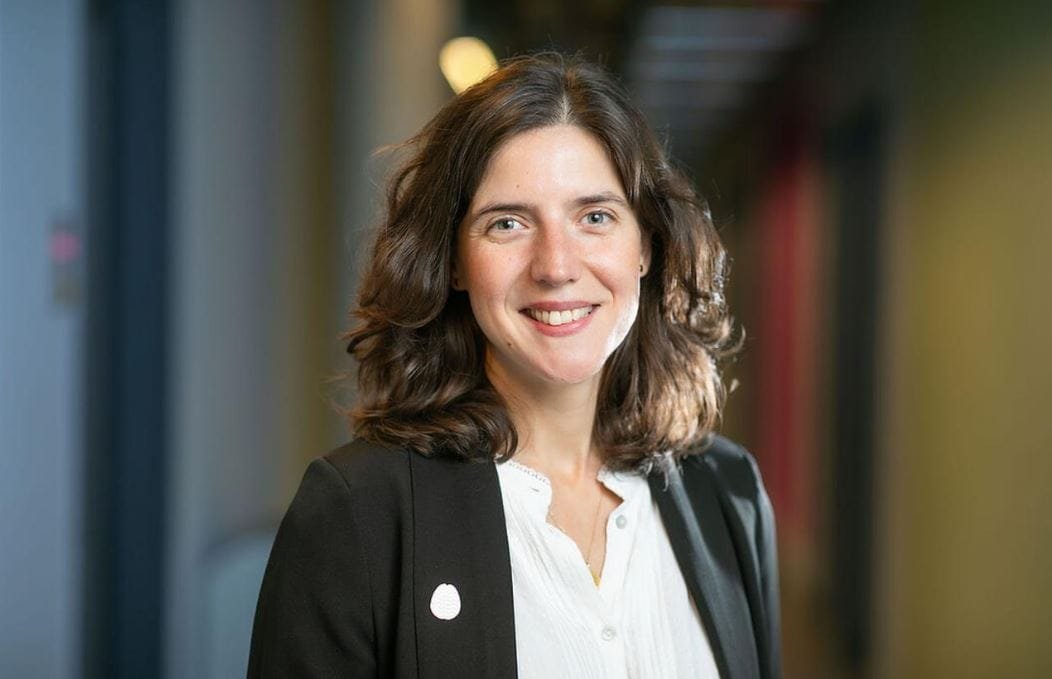
Fatma Deniz, who graduated top of her class from Bursa Girls’ High School, was elected president of TU Berlin after Caltech and Berkeley. The story of a scientist building a bridge between the brain and artificial intelligence.
Technische Universität Berlin (TU Berlin), one of Germany’s leading technical universities, is led for the first time in its history by a president of Turkish origin. Computer scientist and cognitive neuroscientist Prof. Dr. Fatma Deniz was elected president with 42 votes in the university’s Extended Academic Senate.
With this result, Deniz left her rival, incumbent president Geraldine Rauch, behind by more than twice as many votes and became the first president of TU Berlin of Turkish origin. Deniz took up her new post on 1 April 2026.
Prof. Dr. Fatma Deniz was born in Munich in 1983 to a Turkish family and completed her secondary education in Bursa, Turkey. After graduating top of her class from Bursa Girls’ High School, where she studied from 1997 to 2001, she returned to Germany for university. In 2008 she completed her computer science studies at the Technical University of Munich (TUM) with a Diplom degree.
Continuing her academic journey in the United States, Deniz carried out her diploma thesis research in computation and neural systems at the California Institute of Technology (Caltech) in 2007–2008. She then completed her doctorate in computer science in a collaboration between TU Berlin and the Bernstein Center for Computational Neuroscience.
In her postdoctoral career, Deniz worked as a researcher at the University of California, Berkeley from 2013 to 2020. During this period she carried out postdoctoral research at the Helen Wills Neuroscience Institute and the International Computer Science Institute. She also worked as a Moore-Sloan Fellow at the Berkeley Institute for Data Science, where she taught courses in data science.
Returning to Germany in 2020, Fatma Deniz began her academic work at TU Berlin to lead the project “Language Representations in Bilingual Speakers”. Appointed professor of computer science at TU Berlin in April 2023, Deniz took over as head of the department “Language and Communication in Biological and Artificial Systems” the same year. In April 2024 she joined the university’s leadership as vice president for digitalisation and sustainability.
Research Building a Bridge Between Language, the Brain and Artificial Intelligence
In her academic work, Fatma Deniz stands out for pioneering approaches that combine the question of how the human brain processes language with artificial intelligence technologies. Seeking an answer to the question “How does the human brain understand language?”, Deniz uses advanced brain imaging methods (e.g. fMRI) to study the neurobiological mechanisms by which the brain processes words, speech and meaning. She hopes her findings will contribute both to understanding language processing in healthy individuals and to addressing language disorders.
The second pillar of Deniz’s research focuses on giving artificial intelligence a human-like understanding of language. Seeking to develop AI models inspired by the language processing that takes place in the human brain, Deniz aims, for example, to teach artificial systems the responses that occur in the brain when we hear a word. In this way, she expects it will be possible to build AI models that interpret language more accurately and in a more human-like way. This work also paves the way for technologies aimed at reading thoughts or intentions from brain signals.
Third, Prof. Deniz is developing a comparative perspective between biological and artificial systems. By examining side by side how the human brain and AI algorithms process language, she brings out their similarities and differences. The aim is to better understand the interaction between neural structures and artificial systems and so to advance both fields.
This multidisciplinary work has the potential to shape the communication technologies of the future. It is said that Fatma Deniz’s findings could form the basis of many innovative applications, from enabling people who have lost the ability to speak to communicate through brain–machine interfaces to the development of more “human-like” AI systems. In short, Prof. Dr. Fatma Deniz is counted among the scientists who bring different fields of science together by removing the boundaries between neuroscience and artificial intelligence, shaping the technologies of the future.
A Historic Appointment in Berlin and a Success Story with Migrant Roots
By being elected president of TU Berlin with an overwhelming majority of 42 votes, Fatma Deniz achieved a first not only in her personal career but also in Germany’s academic history. For the first time, a scientist of Turkish origin rises to the top executive position at TU Berlin, whose founding dates back to the 19th century.
Deniz taking office at this institution, still regarded as one of Europe’s most respected technical universities, is seen as an important milestone for the Turkish academic community in Europe. Indeed, as a member of a migrant family who has risen to the top of the scientific world in Germany, Prof. Deniz is an example who inspires many young people.
In a statement after the election, Deniz thanked everyone for their trust and set out her vision for TU Berlin in these words:
“Our shared goal is to create a modern technical university that embodies scientific excellence.”
This statement reflects her determination to carry the university into the future through both her innovative research and her approach to leadership. Many people and institutions, including Berlin’s Governing Mayor Kai Wegner, congratulated Deniz on social media and celebrated this success.
With her education in Turkey and Germany and her scientific experience in America, Prof. Dr. Fatma Deniz puts her international experience at the service of humanity. Her journey, from her schooling that began in Bursa to her research years in Munich and California, once again shows both the building blocks of her success and the borderless nature of science.
Fatma Deniz’s achievement as the new president of TU Berlin is a source of pride for both the Turkish community and the scientific world. We can safely say that this success story not only highlights how far a scientist of migrant origin can come through determination and merit, but will also inspire similar successes in the future.
Sources
- tr.wikipedia.org tr.wikipedia.org
- Türkiye Today turkiyetoday.com
- DW Türkçe dw.com
- IHA iha.news
- TU Berlin tu.berlin
The views expressed in this article are the author’s own and do not necessarily reflect PUGAT’s institutional position. Editorial Principles
Monthly · free
Compass of the Month
PUGAT’s monthly newsletter.
Read next


What is PUGAT? A non-profit community publishing independent analysis from Europe on security, migration and society in Turkish, German and English.
Go to the homepage