

Who determines the leadership of a main opposition party, delegates or courts? The ruling of absolute nullity against the CHP gives concrete form in Turkey to the thesis that democracies are eroded not by tanks but by tools that look legal.
Who determines the leadership of a country’s main opposition party: delegates or courts? In discussions of democracy, this is a question that should normally have been answered long ago, at the most basic level.
On 21 May 2026 the 36th Civil Chamber of the Ankara Regional Court of Appeal declared the CHP’s 38th Ordinary Congress, held on 4–5 November 2023, and the 21st Extraordinary Congress that followed it “absolutely null and void” (mutlak butlan). The ruling shows that in Turkey this question has still not been answered.
Under the ruling, Özgür Özel and his leadership were provisionally removed from office, and the leadership of Kemal Kılıçdaroğlu was ordered to take over. On 24 May the police evacuated the CHP headquarters. So direct an intervention by a court in the internal workings of a political party is a striking snapshot of where Turkey’s democratic standards stand. The case has been under appeal at the Court of Cassation since July 2026. Meanwhile, on 24 July 2026, Özgür Özel and 91 members of parliament resigned from the CHP and submitted the founding petition of the Yeni Parti (New Party) to the Interior Ministry.
Where Does Judicial Independence Begin?
Let us set aside the legal and technical dimensions of the matter, because there is something else we need to think about. In a democracy, can the judiciary decide who will run political parties?
In European democracies the answer is clear. Internal party elections are decided by the will of the delegates. The judiciary steps in only in cases of clear procedural violations, and even then within a very narrow framework.
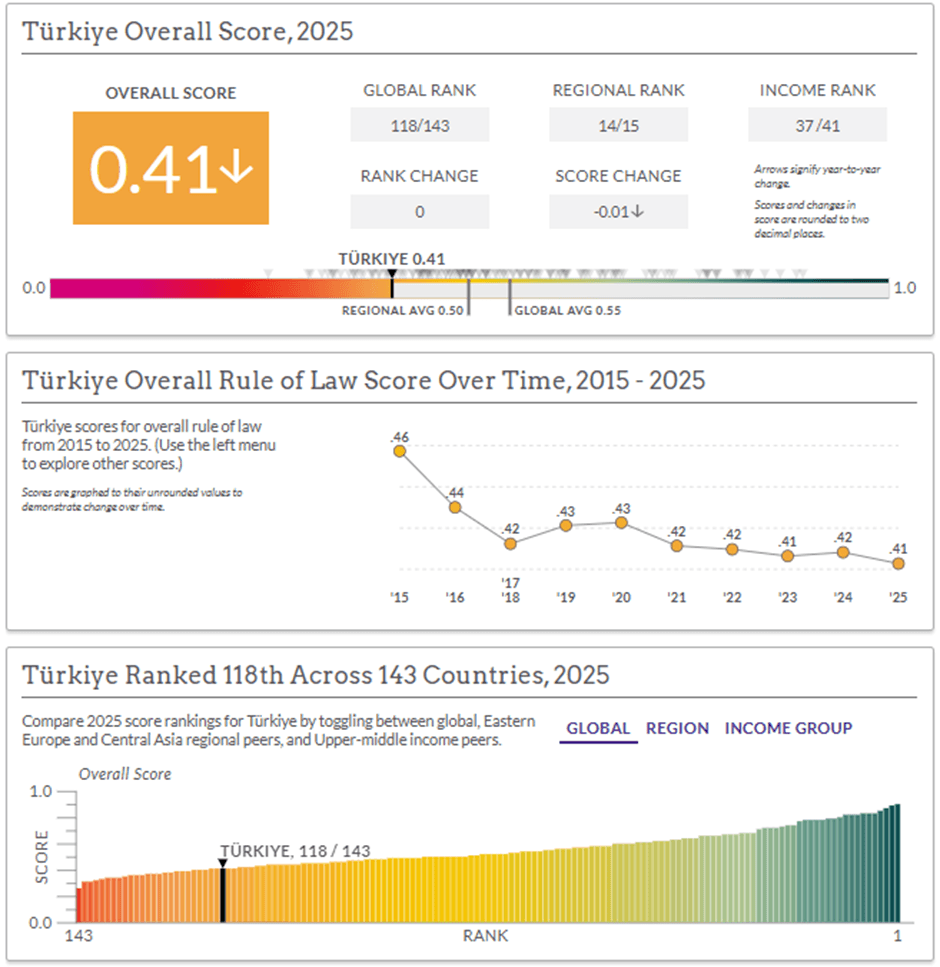
In Turkey, however, judicial independence has long been in question. According to the World Justice Project’s 2025 Rule of Law Index, Turkey ranks 118th out of 143 countries. It is 136th in the category of constraints on government powers and 134th in fundamental rights, just one place above Russia. Against this backdrop, the judiciary intervening in political parties is no longer a surprise.
How Do Democracies Die?
The Harvard political scientists Steven Levitsky and Daniel Ziblatt made a strong impact with How Democracies Die, published in 2018 and translated into more than 30 languages. In an interview with NPR they summarised their thesis roughly as follows: modern democracies are no longer brought down by tanks and coups. They are eroded from within, by elected leaders, using tools that look legal. When courts, electoral boards, constitutional amendments, all these institutional mechanisms, are brought one by one under the tutelage of those in power, democracy carries on on paper but has in fact collapsed.
Interestingly, the authors themselves name Turkey among the countries experiencing democratic backsliding. The review of the book in Harvard’s ReVista puts it strikingly: backsliding countries grab the headlines and our attention, yet for every Hungary, Turkey and Venezuela there is a Colombia, Sri Lanka or Tunisia. In this framework Turkey is seen not as an “exceptional case” but as part of a pattern of democratic erosion familiar to comparative political science.
The “mutlak butlan” ruling against the CHP is a textbook example of this thesis. There is no coup, no tanks. There is a court ruling, documents bearing official seals, articles of law. Everything appears to comply with legal procedure. Yet the result is that the leadership of a country’s main opposition party has been changed by a court. This is exactly the “cloak of legitimacy” Levitsky and Ziblatt describe.
Similar examples can be found in Europe’s recent history. In Poland, under the Law and Justice government, control of the courts was seized and opponents were targeted. In Hungary, Viktor Orbán neutralised the opposition by bringing the judiciary and the media under his control. In both countries the EU’s response was late and inadequate. The picture in Turkey is related to these examples, and at a more advanced stage.
Resistance Is an Achievement
The reactions that followed the ruling are also remarkable. A rare consensus emerged among opposition parties on this issue. Citizens are protesting in the streets. Whatever their political leanings, voices are rising against the judiciary shaping politics. It is not often in Turkey that a cross-party principle is defended, namely that delegates, not courts, should decide who runs political parties.
This reaction is itself an achievement, because becoming inured is more dangerous than any violation of the law. When society stays silent, each new intervention is built on the normalisation of the previous one. We saw the most painful example of this during the emergency decree (KHK) process. Through state-of-emergency decrees, more than 125,000 public servants were dismissed, their passports revoked, their bank accounts frozen, and together with their families millions of people were condemned to “civil death”. Academics, teachers, judges, officers, police officers, doctors. People from almost every part of society. And what did the rest of society do? Almost nothing. Those who said “It’s not my problem”, those who brushed it off with “They must have done something”, those who hid behind fear and comfort. That silence laid the stones of the road leading to today’s replacement of the main opposition party’s leadership by court ruling. A society that kept quiet about the decrees is far easier to force into accepting the annulment of a party congress. This is how the chain of normalisation works. Every link met with silence makes the next one possible.
We can be sure that European institutions are following these developments closely. Judicial independence has always been a critical item in the EU’s assessments of Turkey. Political foundations, human rights organisations and the media in Germany include such rulings in their reports. The voices of objection rising from Turkey find an echo in international public opinion. Whether all this close monitoring, objection and reporting achieves anything in practice is another matter.
Looking Beyond the Cloak of Legitimacy
Levitsky and Ziblatt underline that what protects democracies is not only constitutions and laws but also how society defends those laws. Written rules can always be manipulated. What cannot be manipulated are a society’s democratic reflexes. A court ruling can change the leadership of the main opposition party. But it cannot erase the memory of the millions who objected to that ruling.
Not only the “mutlak butlan” ruling, not only the lawlessness of the emergency decrees: many of the issues Turkey faces today are visible links in the process of democracy being eroded under a “cloak of legitimacy”. Only a society that chooses not to become inured to injustice can break this chain. Turkey has long since passed the point of expecting salvation from a court ruling or a government statement.
In the hours when the CHP headquarters was being evacuated under police escort, the citizens waiting in front of the building carried neither weapons nor flags. They were simply standing there. That stance was perhaps the first and most important step towards overcoming this crisis. Let us hope it is not too late for the steps that must follow.
Sources
- Steven Levitsky, Daniel Ziblatt, How Democracies Die (2018)
- World Justice Project – Rule of Law Index 2025 worldjusticeproject.org
- European Commission – Türkiye Report enlargement.ec.europa.eu
The views expressed in this article are the author’s own and do not necessarily reflect PUGAT’s institutional position. Editorial Principles
Monthly · free
Compass of the Month
PUGAT’s monthly newsletter.
Read next


What is PUGAT? A non-profit community publishing independent analysis from Europe on security, migration and society in Turkish, German and English.
Go to the homepage