
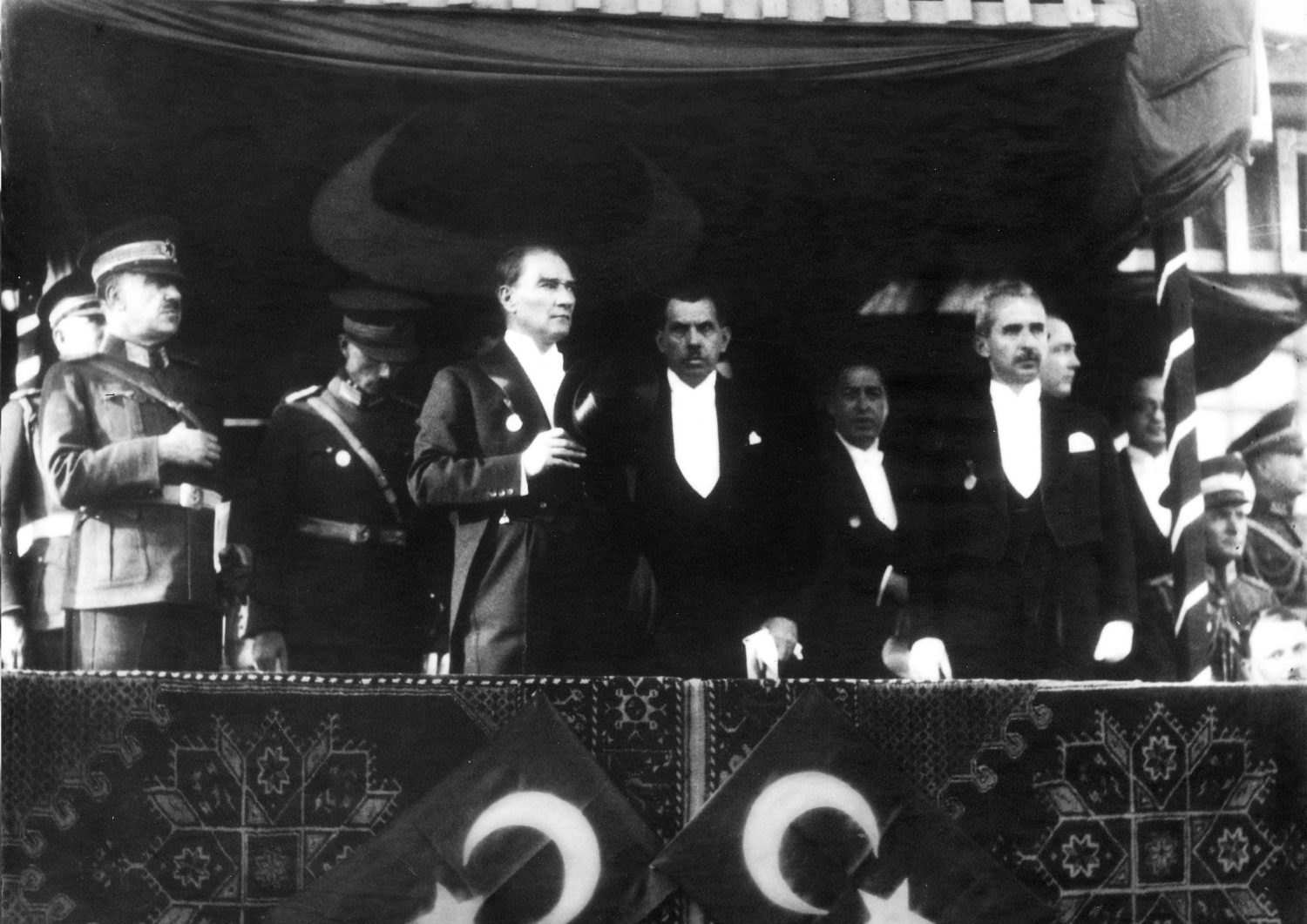
The Republic is a hundred years old. But its record on democracy, press freedom, judicial independence and minority rights adds a bittersweet loneliness to the joy of the celebration.
Image: Republic of Turkey / Wikimedia Commons, Public domain
A full hundred years have passed since the founding of the Republic of Turkey. If only we could celebrate this special year without having to express the bittersweet feelings we carry within us. Over its hundred-year history this land has come through many ordeals and seen countless generations. Yet sadly, today we still face a picture in which democratic, libertarian and peace-loving values have not taken root to the extent we hoped, and have instead regressed from time to time.
The Republic’s Legacy of Reform and the Test of Democracy
With the proclamation of the Republic, reforms were carried out in many fields, from the legal system to education, from language to the arts. Yet when we look at democracy surveys, freedom indices and international peace measurements on the centenary, we see that these values have not advanced steadily in Turkey. In its 2018 report titled “Democracy in Crisis”, for example, the Washington-based Freedom House for the first time downgraded Turkey from the “partly free” category to the “not free” category. This stands in contrast to the positive developments that were expected towards the end of the century.
Press Freedom and Judicial Independence: The Pains of a Century
The troubles of the hundred-year-old Republic with press freedom have never diminished. Arrests of journalists, state control over the media and allegations of censorship have increased the concerns not only of the country but of international media organisations day by day. In assessments of internet freedom, too, Turkey keeps playing in the “Not Free” league, with frequent access bans and restrictions on social media platforms.
Besides these, judicial independence and the functioning of the justice system are a major problem area in their own right. The politicisation of the judiciary, arbitrary arrests and the damage done to the rule of law have been a constant item on the agenda under every government. Examples of the law being bent and twisted to serve political interests, and the ravings that “the law is the dog of politics”, in particular, are clear signs that justice is drifting ever further from universal principles.
Minority Rights and the Search for Peace in Foreign Policy
Turkey’s hundred-year report card on the rights of ethnic and religious minorities is, unfortunately, also full of failing grades. The Kurdish question in particular has still not been resolved. Overshadowed at times by violence, conflict and jingoistic speeches, this issue remains one of the important matters awaiting a solution. The positive steps needed on discrimination, social injustice and the right to equal citizenship have, sadly, never been taken.
In foreign policy, Turkey’s “zero problems” policy could not be implemented effectively. The principle of good relations with neighbours and of preferring peaceful solutions, one of the cornerstones of a peace-loving stance, has taken blow after blow. Cross-border operations, regional tensions and the replacement of diplomatic language by harsh statements have pushed the country ever further from the horizon of “Peace at home, peace in the world”. The eagerness to take on the role of “pioneer of peace” in the international arena now rings in our ears only as rhetoric aimed at domestic politics. Yet a sustainable and stable foreign policy had the potential to increase and strengthen Turkey’s standing regionally and globally.
Are We Ready for the Second Century?
In the first hundred years, the hope of embracing the founding ideals of the Republic anew and placing democracy, freedoms and peace back at the centre of our lives did not make it onto our agenda even as much as an anniversary event. These values are indispensable elements of social development and progress, and they can only be preserved through a continuous process of self-criticism and renewal.
So how can we ensure that in its next hundred years Turkey leaves behind the loneliness of the first and enters a process of building a democratic, libertarian and peace-loving future?
Taking the centenary as an occasion, how can we ensure that concrete steps are taken to solve all these problems, that a culture of national consensus and dialogue is nurtured, and that Turkey sets sail towards a bright future?
A Process of Renewal: Pioneering Steps in Civil Society, Freedoms and Education
Developing concrete proposals for the problems that need solving is the duty of us all. For Turkey to have a vision of a “second century” in which democratic, libertarian and peace-loving values grow stronger, we must set out from at least one of the fields in which we are influential or involved.
We must look to the future with hope and take concrete steps without losing heart in the face of difficulties. The Republic’s centenary brings not only an occasion to assess the past but also an opportunity to make a new start towards fundamental change. A hundred years of accumulated experience is full of mistakes as well as, here and there, individual success stories, and now is exactly the time to use this experience to draw up a guide for the steps forward. What can we do?
- We can take the first step by strengthening civil society organisations that represent different sections of society. Giving them more room is an important step towards strengthening democracy and freedoms. These organisations can contribute to government policy in a balanced way, take a critical stance when necessary and make a marginal contribution to solving social problems.
- For the sake of judicial independence, we must first sincerely want a legal system completely free from political influence and pressure, acting solely on the principle of equality before the law. Then we must find legitimate ways to fight for this goal. This is essential for the rule of law to function soundly.
- Press freedom is one of the cornerstones of a democratic society. We must raise our voices together against the anti-democratic practices journalists are subjected to. Otherwise it will not be possible to reduce the control of the state or other authoritarian mechanisms over the media and to prevent censorship.
- An education system that encourages democratic values and critical thinking is essential for building the foundations of a free society. To speed up this process, we must ensure that projects and courses embracing human rights, civil liberties and multiculturalism are added to curricula.
- Strong legal provisions should be introduced that guarantee the rights of groups who define themselves by different names across the ethnic and religious spectrum, without subjecting them to discrimination, and that ensure they too are seen as equal individuals in society. This is a critical step for achieving social peace, unity and solidarity in a sustainable way.
- A foreign policy strategy based on dialogue and cooperation, which gives importance and priority to peaceful relations with neighbours and other nations, should be created. In regional or global conflicts we should be not the country that fans the flames but an actor taking on active roles such as peacebuilding.
- We must develop and strengthen a model of participatory democracy that allows every section of society to make its voice heard, in which all citizens are involved more fully and effectively in decision-making and mechanisms such as referendums and citizens’ assemblies are strengthened.
- Whatever is necessary must be done to fully guarantee freedom of expression: opening up a broad space of freedom so that individuals can express their thoughts freely, removing restrictions on freedoms entirely, and securing these rights legally and administratively in line with universal principles.
These proposals are only some of the steps that must be taken for Turkey to emerge as soon as possible from its hundred years of loneliness. There seems to be no other remedy for reaching a legitimate and workable climate of social peace and freedom.
Sources
- Freedom House – Freedom in the World freedomhouse.org
- Reporters Without Borders – World Press Freedom Index rsf.org
The views expressed in this article are the author’s own and do not necessarily reflect PUGAT’s institutional position. Editorial Principles
Monthly · free
Compass of the Month
PUGAT’s monthly newsletter.
Read next


What is PUGAT? A non-profit community publishing independent analysis from Europe on security, migration and society in Turkish, German and English.
Go to the homepage