

The parameters of Turkey’s Syria policy raise serious concerns: the use of intelligence as a political tool, relations with jihadist groups and weaknesses in border security.
What Is Happening in Syria, What Is Turkey Doing? | 3
We continue to examine the parameters of Turkish–Syrian relations. But this time it is also worth voicing the concerns these parameters have given rise to. Let us start with the intelligence service, which the AKP government, in running its Syria policy, used not only to meet its intelligence needs but also as a political and operational power actor.
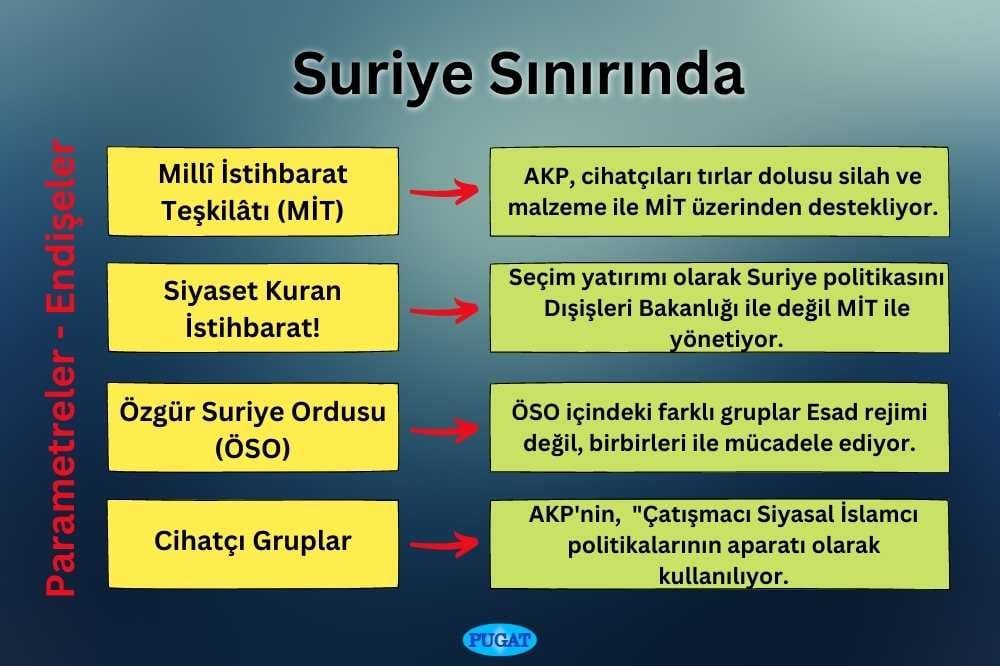
The National Intelligence Organisation (MİT)
When the audio recordings of a meeting held at the Foreign Ministry of the Republic of Turkey on 13 March 2014 were leaked to the media, it also became clear to what extent Salafi-jihadist terrorism was being supported by the AKP government. In this recording, MİT Undersecretary Hakan Fidan spoke of producing a “justification for war” by sending four men to the Syrian side to have eight missiles fired at Turkish territory and having someone attack the Tomb of Süleyman Shah. And the senior officials taking part in the meeting (Foreign Minister Ahmet Davutoğlu, MİT Undersecretary Hakan Fidan, Foreign Ministry Undersecretary Feridun Sinirlioğlu and Deputy Chief of the General Staff General Yaşar Güler) made remarks supporting these ideas.
In the same recording Fidan also spoke of some 2,000 truckloads of materiel sent to the forces fighting the Syrian regime. Developments inside Turkey’s borders after this conversation can be seen as a sign that this number reached a much higher level.
Indeed, as will be recalled, following a tip-off that weapons and bombs were being carried illegally from Turkey to Syria, it was established that trucks stopped on Turkish soil in the provinces of Hatay and Adana in January 2014 were carrying weapons, ammunition, rockets and missile shells.
More recently, on 13 January 2020, MİT President Hakan Fidan and Ali Mamlouk, head of Syria’s National Security Bureau, held a meeting in Moscow. According to press reports, at this meeting the Turkish side called for an end to the YPG presence on the Syrian border, and the Syrian side for Turkey’s complete withdrawal from Syrian territory. In other words, nothing has changed on the ground from the start.
Intelligence That Makes Politics!
The fact that the tool the AKP government primarily and functionally used to run its Syria policy was the intelligence service (MİT) rather than the Foreign Ministry or another ministry, and that the wrong policies pursued were carried out not by the political government but by the state’s intelligence service, was interpreted in domestic political debate as an electoral investment. That is to say, it appears that MİT was used as an effective tool so that the bill for any mistakes would not be presented to the AKP government or to the AKP as a political party. Indeed, to support this practice, a number of changes were made to the MİT law, both cloaking intelligence employees in immunity and endowing the organisation with operational powers.
In shaping policy in the context of developments in the region, steering those developments and assessing their possible effects on the country, the legislature and the executive appear to have been ineffective.
Existing laws were shelved, and a suitable cover, that is, new laws, was prepared for what was being done or was intended to be done. At times even this was considered unnecessary, and the course continued with faits accomplis, secrecy and reticence. As a result of this mindset, the AKP government bypassed the entire state apparatus in setting Syria policy, rendering it dysfunctional, and gave MİT very critical roles. As a consequence of this wrong policy, both the intelligence service and the efforts to rebuild peace in Syria were badly damaged, and continue to be.
The Free Syrian Army (FSA)
One of the founding aims of all the opposition structures against the Assad regime was to fight to bring the Assad regime down. But many of these structures that took to the battlefield soon began fighting not the Assad regime but each other. Although it differs in some respects, we can see the FSA as one of these structures as well.
The FSA included members of nearly 100 different groups or factions with different motivations. And most of the groups gathered under the FSA umbrella adopted Islamist currents, some moderate and some radical. Their aims and expectations allowed these people to find a place in various armed groups, especially jihadist ones. In this way the FSA became an important source of trained fighters for jihadist groups.
Jihadist Groups
The pragmatism the AKP set out to represent, at first covertly and later openly, which we might also call “confrontational political Islamism”, produced baseless, inconsistent policies fed by blood both in Turkey and in the Middle East.
The gravest of these policies, and the one that most threatened hopes for peace, was the support given to terrorist structures fighting in the region such as al-Qaeda, al-Nusra, ISIS and Ahrar al-Sham. That these structures, which all essentially share the same (Salafi-takfiri-jihadist) ideological motivations, were supported by AKP cadres with a sympathy in line with their affinity for the Muslim Brotherhood is also noteworthy for understanding in which direction the AKP government and its ideologues were trying to channel developments in Syria.
The Salafi-jihadist organisations given political and logistical support by the AKP government managed to survive over time thanks to this support. They fought sometimes the Assad regime, sometimes other groups in the region such as the Kurds, and at times other targets indicated by the AKP government. We can say that the PYD took priority among these targets.
The AKP government’s reckless support for Salafi-jihadist terrorist organisations, independent of the understandings reached with international power centres, in order to prevent the Kurds near the Turkish border from taking the initiative, did not escape the attention of world public opinion. But the absence of a properly functioning international coordination in the region meant that criticism of Turkey remained feeble. Thus the support provided by the AKP government to Salafi-jihadist terrorism continued in plain sight.
The PKK-PYD and the Syrian Kurds
All the PYD and other Kurdish-origin groups engaged in armed activity in the region (as long as they do not come under the FSA umbrella) are regarded by the AKP government as equivalent to the PKK terrorist organisation. This has not changed from the start. One might think there is no problem with this from the standpoint of Turkey’s security and national interests. But the problems arising here stem from the fact that the armed Kurdish groups are supported by the international coalition forces, above all the US, and by Russia.
For example, many US officials have held countless meetings to date with Ferhat Abdi Şahin, code-named Mazloum Kobani, who is called the General Commander of the Syrian Democratic Forces (SDF). The legend circulating among Kurds that this person is the spiritual son of terrorist organisation leader Abdullah Öcalan has given him a legendary status. But there is also an evident fact: Ferhat Abdi Şahin, a member of the PKK terrorist organisation since the 1990s, carried out bloody attacks at many levels of the organisation, above all in regional command and “special force” roles. Dozens of accounts of these attacks appear in court files in the statements of captured or surrendered members of the organisation.
There is no overlap whatsoever between Turkey’s reasons for fighting the activities of armed Kurdish groups and other countries’ reasons for supporting Kurdish groups. What is interesting is that no large-scale conflict has arisen from these opposing policies between Turkey on the one hand and the US, European countries and Russia on the other. A policy of controlled tension, as it were, is being pursued regarding the Kurds in the region. And no side is willing to have its own truths questioned. For now, let us simply note that this subject needs to be examined in detail.
The issue also has this dimension for Turkey: the PKK terrorism that has continued in the country for 40 years is the main reason for cautious state policies towards the Kurds. This caution was exaggerated or exploited by some politicians, and used by others as the main motivation of nationalist policies to marginalise the Kurds and turn them into material for domestic politics. The rhetoric voiced by official mouths, “We distinguish between the PKK and the Kurdish people”, has never found a response among the Kurds that would endorse the government’s policies anyway.
(End of Part 2)
(Part 3: Turkey’s Ordeal with Syrian Migrants – to be continued)
The views expressed in this article are the author’s own and do not necessarily reflect PUGAT’s institutional position. Editorial Principles
Monthly · free
Compass of the Month
PUGAT’s monthly newsletter.
Read next


What is PUGAT? A non-profit community publishing independent analysis from Europe on security, migration and society in Turkish, German and English.
Go to the homepage