
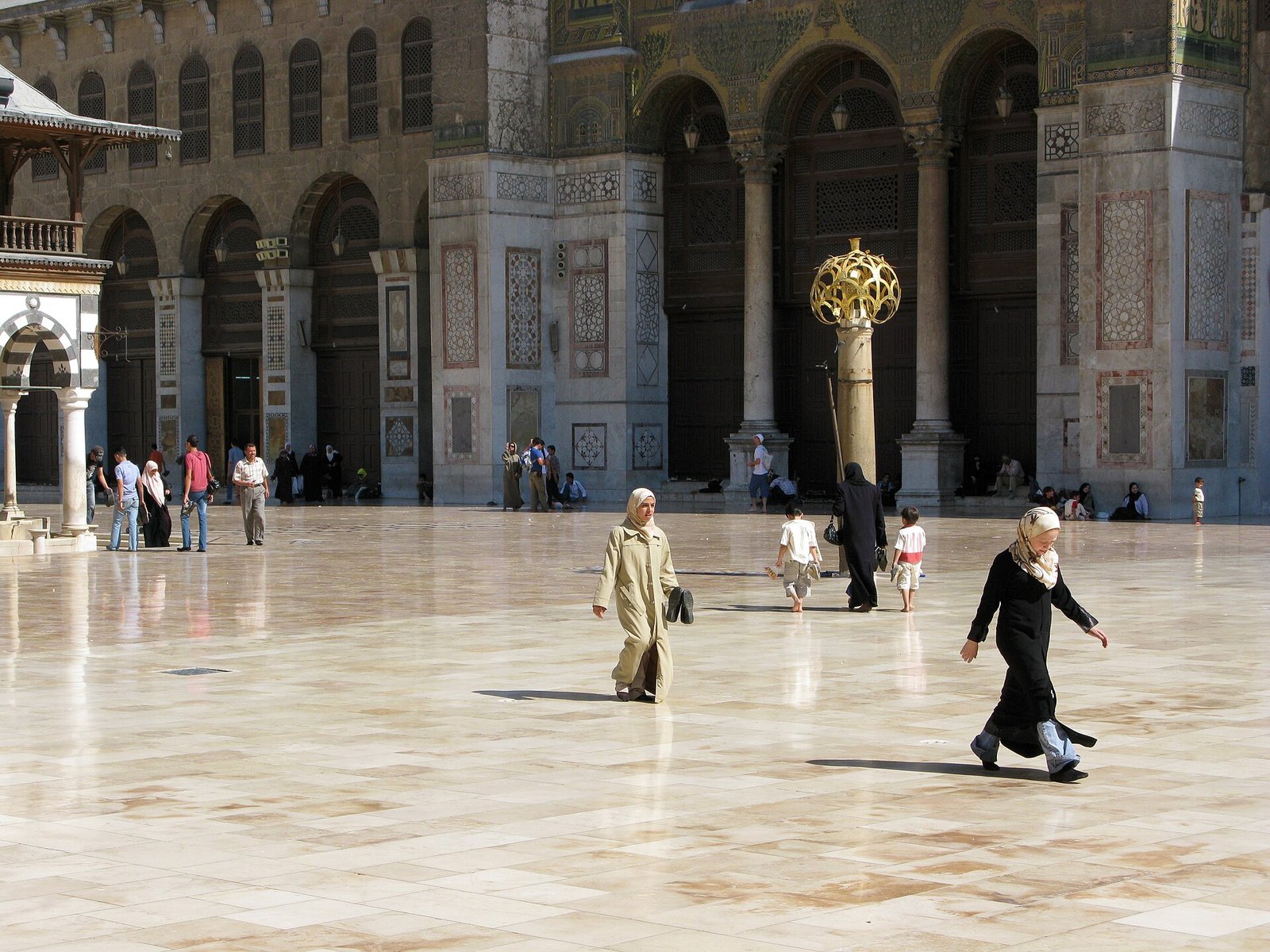
Relations that improved with the 1998 Adana Agreement rose to the level of “brotherhood” after 2002. The zero-problems policy and the 1 March motion prepared the ground for this rapprochement.
– Turkey’s Syria Policy –
Relations, which had begun to improve with the 1998 Adana Agreement, entered a new phase with the Justice and Development Party (AKP), which came to power in 2002 and had a political Islamist identity. In the AKP government’s early days relations with Syria improved to the point of joint cabinet meetings. The then Prime Minister Recep Tayyip Erdoğan addressed Bashar al-Assad as “my brother”, and even the abolition of the border between the two countries came onto the agenda.[i]
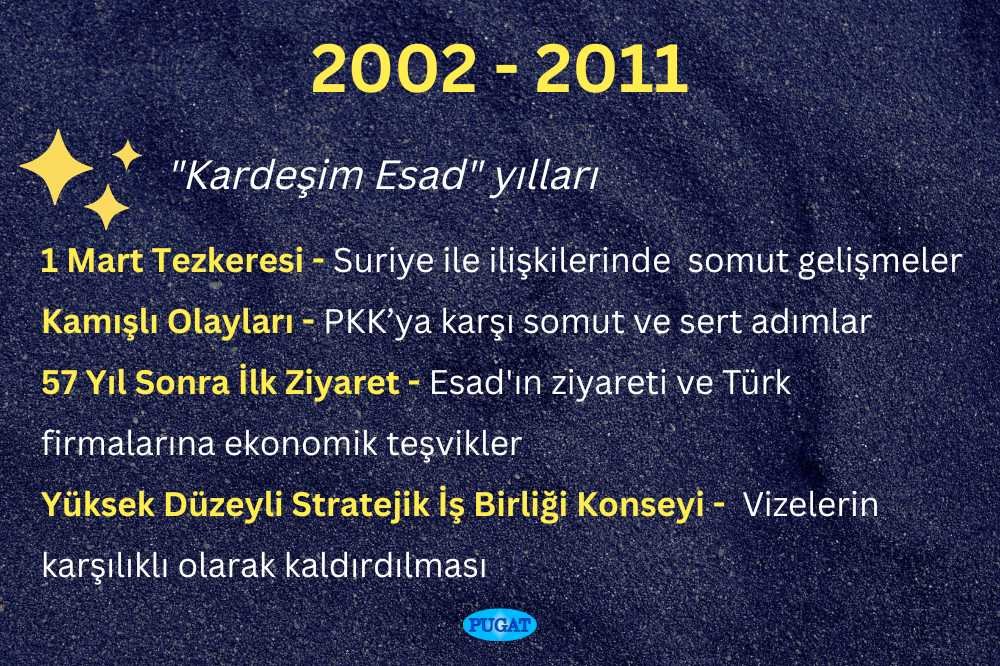
Within the framework of the “zero problems with neighbours” policy it adopted in the early 2000s, Turkey began to abandon its long-standing approach of being close to Western countries and distant from Eastern ones, and sought to build relations with Eastern countries as close as those with the West.
The 1 March Motion
During the second Gulf War, the 1 March motion, which provided for support for the US invasion of Iraq, had been rejected by the Turkish Grand National Assembly. Turkey’s statement that it would not join the US-led coalition had pleased Syria and Iran.
Syria’s ethnic and sectarian structure, with characteristics similar to Iraq’s, heightened Assad’s fears about the consequences of the invasion in particular. For Assad considered it inevitable that Syria would be next after Iraq. In this sense Turkey’s stance towards the US reassured Iraq’s neighbours, Syria above all, and opened the door to relatively concrete progress in relations with Syria.
The Qamishli Events
With the US invasion of Iraq, the Kurdish question entered a new phase for both Turkey and Syria. Although Syria had withdrawn its support for the PKK under the Adana Agreement, it had not launched an open fight against the terrorist organisation for fear of creating problems with Syria’s Kurdish population. But the clashes that broke out after a football match in Qamishli in March 2004 and took on an anti-Assad character increased Syria’s sensitivity to its own Kurdish question and to developments in the Kurdish political movement in northern Iraq.[ii]
After the events in Qamishli, clear changes were observed in the Syrian government’s attitude towards the PKK. Syria began to take more concrete and tougher steps against the organisation’s offshoots. In this context Syria:
- handed over a total of 73 members of the PKK terrorist organisation to Turkey between 2003 and 2007,
- officially condemned for the first time an attack carried out by the PKK in Bingöl in July 2005,
- and in October 2007, when Turkey put a cross-border operation into northern Iraq on its agenda despite US objections, announced (through Bashar al-Assad) that it would stand behind such a military measure, supporting a Turkish operation in northern Iraq for the first time.[iii]
The First Visit in 57 Years
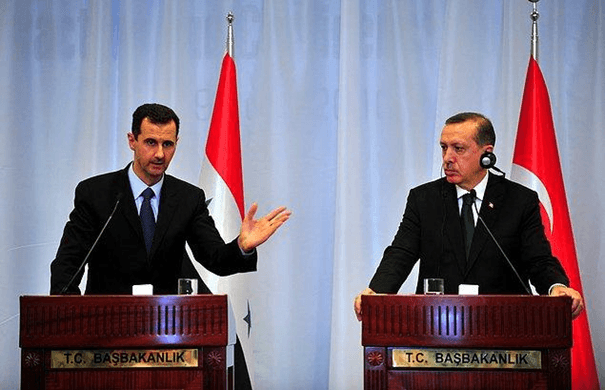
Syrian–Turkish relations rose to a higher level with the official visit to Turkey by Syrian President Bashar al-Assad on 6 January 2004. Although the Adana Agreement is regarded as the turning point in Syrian–Turkish relations, Assad’s visit, as the first Syrian president to visit Turkey in 57 years, is also an important milestone.[iv] This visit was followed by Damascus visits by the then Prime Minister Recep Tayyip Erdoğan in December 2004 and President Ahmet Necdet Sezer in April 2005.
In this process, in which both sides had expectations of each other, the AKP saw Syria as a bridge to the vast market of the Arab world, while Bashar al-Assad, who wanted to move from a state-run economy to a liberal one, saw Turkey, an EU candidate, as a large market. The customs exemptions Syria enjoyed as a member of the Council of Arab Economic Unity whetted the AKP’s appetite, and some companies were therefore encouraged to open factories and manufacture in Syria.
Full Support from Assad for a Cross-Border Operation
In 2007 Bashar al-Assad visited Turkey once again, this time as the official guest of the then President Abdullah Gül. In the talks Assad announced his full support for the cross-border operation Turkey was considering in its fight against terrorism, while stressing that Iraq’s territorial integrity and national unity must be preserved.
In fact Assad’s concern over Iraq was also a sign of how far he foresaw the situation Syria itself would fall into. During this visit, President Abdullah Gül’s statement that Turkey supported Syria’s position against Israel on the Golan Heights was important for Assad. Erdoğan, however, would later try to use this support to win favour with the West and the US, and would achieve nothing.
Turkey as Mediator Between Israel and Syria
In this period Turkey’s diplomatic relations with Syria also began to show visible movement. Peace talks between Syria and Israel, launched in 2000 with US mediation to resolve the dispute over Israel’s occupation of the Golan Heights in 1967, had ended without result. However, on 21 May 2008 it was announced that peace talks between Israel and Syria had resumed within the framework of the “intensive efforts over a long period” and telephone diplomacy of the then Prime Minister Erdoğan. Yet Israel’s launch of an operation in Gaza led Syria to protest and withdraw from the talks. Turkey’s mediation therefore came to an end as well.[v]
Ahmet Davutoğlu, who served as foreign policy adviser to Abdullah Gül and Recep Tayyip Erdoğan between 2003 and 2009 and was appointed Foreign Minister in 2009, had a great influence on Turkey’s opening to the Middle East. Davutoğlu stated that, from Syria’s point of view, Turkey was its gateway to the north and west, while Syria was Turkey’s gateway to the south (the Middle East), and that, quite contrary to issues seen as areas of conflict such as shared water basins, there was extraordinary potential in fields such as agriculture, trade and transport.[vi]
The Turkey–Syria High-Level Strategic Cooperation Council
In this context Turkey began to develop in every respect its relations with Syria, with which it has deep social, historical and cultural ties. The Turkey–Syria High-Level Strategic Cooperation Council, established on 16 September 2009 to contribute to peace, security and stability in the region and to sustainable economic development, and the mutual lifting of visas in October 2009 were concrete steps in this direction.
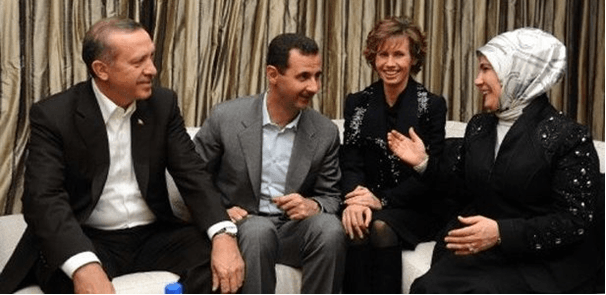
Bashar al-Assad’s visits to Turkey, the resounding messages of support against US and Israeli policies, Erdoğan addressing Assad as “my brother”, the “friendly” family photos, and the bilateral contacts and cooperation agreements mentioned above had begun to suggest that a real “spring atmosphere” prevailed, when the arrival of the “Arab Spring” in 2010 transformed these relations and this rhetoric completely.
(To be continued)
[i]İskender Serdar, op. cit. p.13
[ii]Oran, Baskın, ‘Türk Dış Politikası – Kurtuluş Savaşından Bugüne Olgular, Belgeler, Yorumlar’, (Cilt III 2001-2012),
p. 414.
[iii]Oran, Baskın, op. cit. p.415
[iv]Atlıoğlu, Yasin, ‘Türkiye’nin Orta Doğu Politikasında Suriye’, Stratejik Öngörü Dergisi TASAM Stratejik Araştırmalar Dergisi, TASAM Yayınları, Year 2, Issue 6, 2005, p. 140.
[v] Yeşilyurt, Nuri, (2013), “Ortadoğu’yla İlişkiler” (ed. Baskın Oran), Türk Dış Politikası Cilt III 2001-2012, Istanbul: İletişim Yayınları. p.419
[vi] Davutoğlu, Ahmet, Stratejik Derinlik, Küre Yayınları, p.402
The views expressed in this article are the author’s own and do not necessarily reflect PUGAT’s institutional position. Editorial Principles
Monthly · free
Compass of the Month
PUGAT’s monthly newsletter.
Read next


What is PUGAT? A non-profit community publishing independent analysis from Europe on security, migration and society in Turkish, German and English.
Go to the homepage