
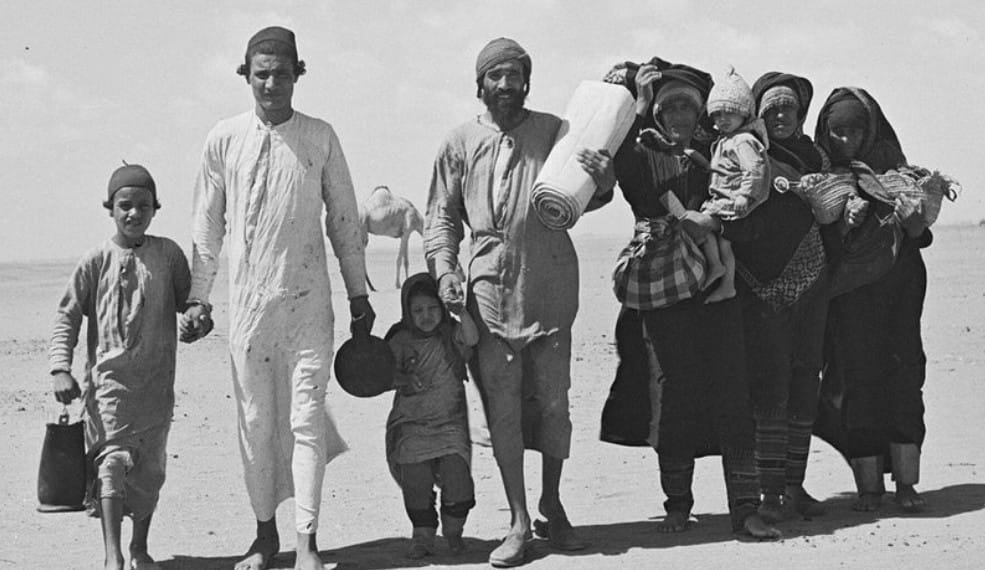
In 1948 world Jewry was associated with the suffering of Europe. In the same years, hundreds of thousands of Jews who had lived in the Arab world for centuries also migrated to Israel; this silent migration still shapes Israeli society today.
When the State of Israel was founded in 1948, world Jewry was generally associated with the suffering endured in Europe. The trauma of the Holocaust, European antisemitism and Ashkenazi identity had become the global centre of Jewish identity.
Yet in the same period, hundreds of thousands of Mizrahi Jews (Eastern Jews) living in the Arab world migrated to Israel, some voluntarily and some under compulsion.
These communities, which had for centuries been an inseparable part of Arab societies in countries such as Iraq, Egypt, Yemen, Morocco and Tunisia, spoke Arabic and lived as productive members of Arab culture.
Indeed, Orit Bashkin also points out that the Jews of Iraq were not only Jews but also part of the Arab enlightenment.[1]
From Coexistence to Rupture
With the founding of Israel, the identity of the “Arab Jew” suddenly became a contradiction. The partition of Palestine, the Arab–Israeli wars and the rise of nationalism squeezed these communities.
Between 1948 and 1970, some 850,000 Jews left Arab countries. Some feared attacks, others joined emigration campaigns encouraged by Zionist organisations.
Events such as the Farhud pogrom in Iraq (1941), the Lavon Affair in Cairo (1954) and Operation Magic Carpet from Yemen (1949–50) were dramatic turning points in this process.
In “Operation Ezra and Nehemiah”, 120,000 Iraqi Jews were moved to Israel in just a year and a half. Most of them left behind a deep-rooted cultural heritage.
A New Struggle in a New Land
The immigrants who reached Israel faced a new test of identity in the “promised land”. The Ashkenazi elites of European origin saw the Mizrahim as “Arabised” and “backward”. Speaking Arabic was considered shameful, Arab music struggled to find a place in public broadcasting, and the immigrants lived for many years in the Ma’abarot, transit camps made up of tents.
The life that took shape in these camps was not only physical deprivation but cultural trauma. For example, the long-established, educated and high-status Jewish community of Baghdad found itself, through forced migration, in Israel’s resource-poor rural order.
The fracture of identity and the security concerns very probably have their origins in the experiences of this period. (We will return to this subject in later articles.)
Ella Shohat describes Mizrahi Jews as both the native voice and the suppressed memory of Israel.[2] While trying to preserve the culture they had brought from the Arab world, they were forced to adapt to the new state’s modernisation project.
A Silent Mirror
For many years the Mizrahi communities waged a struggle of identity between two extremes. On one side stood the modernised, secular and European superiority of the Ashkenazi identity that came from Europe; on the other, a cultural memory carried over from the Arab world but suppressed.
Mizrahi Jews became both the most native and the most “other” community in Israel. Many of them made up Israel’s lower-class labour force, its border settlers or its military ranks. But at the same time they were the group carrying Israel’s deepest Arabic memory. In the following decades this would turn into a strategic advantage in the security bureaucracy, above all in the world of intelligence, but that is another story, and we will take it up in our next article.
Today, among third-generation Mizrahi Jews in Israel, the tendency to rediscover the past from a faith-centred perspective is growing stronger. The story of the Mizrahi Jews holds important clues not only about a migration but also for understanding Israel’s policies today. We could say that they are Israel’s most silent, yet also its deepest mirror.
(To be continued.)
Editorial note: This series of articles examines the role that migration and cultural diversity have played in the formation of Israeli society; it is not intended as a criticism of any religious or national community.
Sources
- Orit Bashkin, New Babylonians: A History of Jews in Modern Iraq. Stanford University Press, 2012.
- Ella Shohat, “Sephardim in Israel: Zionism from the Standpoint of Its Jewish Victims”, Social Text, 1988.
The views expressed in this article are the author’s own and do not necessarily reflect PUGAT’s institutional position. Editorial Principles
Monthly · free
Compass of the Month
PUGAT’s monthly newsletter.
Read next
What is PUGAT? A non-profit community publishing independent analysis from Europe on security, migration and society in Turkish, German and English.
Go to the homepage