

The EU’s Digital Markets Act designates the biggest technology companies, from Google to Meta, as “gatekeepers” and imposes new obligations on them. What will change for users?
Signed by the European Parliament and the Council on 14 September 2022, the European Union’s Digital Markets Act (DMA) was published in the Official Journal of the EU on 12 October 2022. The DMA scrutinises and regulates the activities of large digital companies in particular.
Which Technologies Will Be Affected?
The DMA will affect the core platform services offered by the large companies designated as gatekeepers, above all search engines, social media platforms, video-sharing platforms, messaging apps, operating systems, web browsers, virtual assistants, cloud computing services and advertising services.
Timeline for Implementation
The large technology companies covered by the DMA operate in the EU subject to certain conditions and are required to comply with the law. The date set for the DMA to apply in full is March 2024. In other words, we will begin to feel its effects in the coming days.

Purpose of the Act
The aim of this regulation is to create a fair market in the digital sphere across the EU. It focuses on the services of the key players in the digital market, known as “gatekeepers” (Alphabet, Amazon, Apple, Booking, ByteDance, Meta and Microsoft).
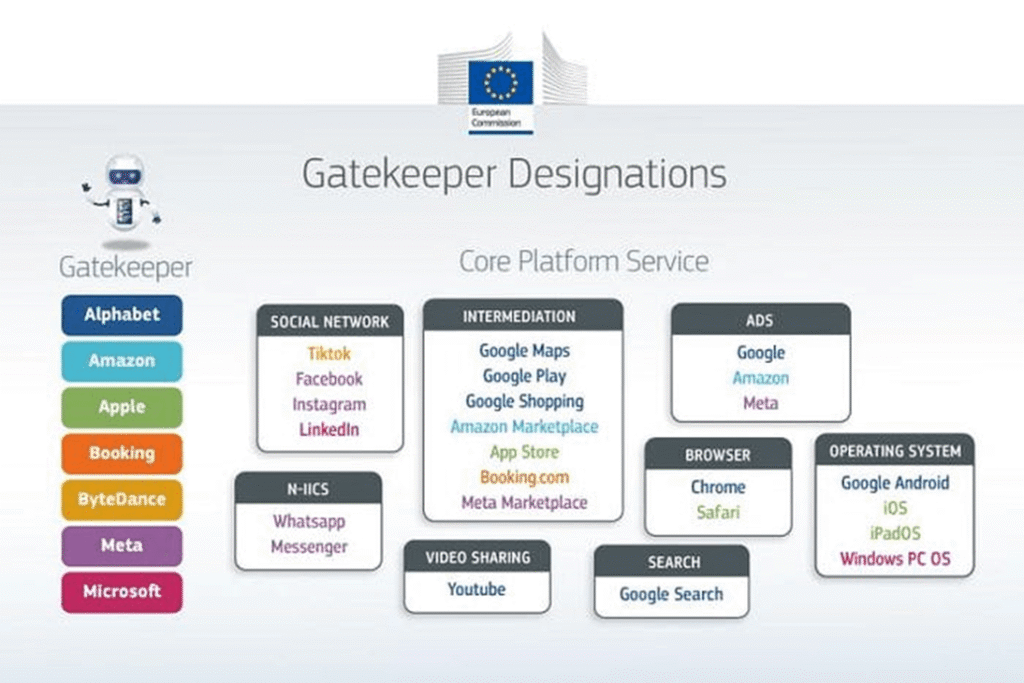
How Were the Gatekeepers Chosen?
The regulation states that gatekeepers were designated on the basis of a company’s impact on the market, its role as an important gateway for business users to reach end users and the expectation that it holds an entrenched and durable position.
In addition, the Commission has the right under the regulation to check at least every three years whether the gatekeepers still meet the requirements and to take action accordingly.
Obligations of the Gatekeepers
Under the regulation, the big players may not use personal data for advertising or other services without consent, may not prevent user complaints from being passed on to the competent authorities, may not force people to use particular services and may not require users to subscribe to additional services. The regulation also contains further restrictions beyond these core points. For more information, you can read the full text here.
Interoperability of Messaging Apps such as WhatsApp
The regulation also requires messaging services designated as gatekeepers to make certain basic functions interoperable with other services that request it. Once the technical integration is in place, people using different messaging apps will be able to communicate with each other.
The regulation also places a strong emphasis on security in messaging apps.
Oversight of the Gatekeepers
The regulation gives the Commission the power to supervise these companies. The Commission will thus be able to open investigations, communicate its findings to the gatekeeper concerned and determine the measures to be taken.
The Public Interest Principle
Under the regulation, the Commission may also grant exemptions from certain obligations on grounds of public health or public security; and if exceptional circumstances beyond a gatekeeper’s control endanger the economic viability of its operations in the EU, it may temporarily suspend certain obligations upon a reasoned request.
A Level Playing Field
Within the powers granted to it, the Commission also has the right to take the necessary measures if it identifies a situation that restricts competition or is unfair.
No Room for Evasion
The regulation also stresses that gatekeepers must not try to circumvent the rules by various means and that proceedings will be opened if such conduct is detected.
Adding New Gatekeepers to the List
The Commission has the right to examine and investigate whether a company should be added to the list of gatekeepers. The regulation also states that certain obligations may be applied to businesses that do not yet hold an entrenched position but are expected to acquire one.
Broad Powers for the Commission
The Commission also has the right to request access to data and algorithms from the gatekeepers concerned. This should remove question marks over how these companies process personal data.
Fines
The Commission has the right to impose fines of up to 10% of worldwide turnover if gatekeepers fail to comply with their obligations. If the same infringement is repeated, the rate can rise to 20%. (Update: In April 2025 the Commission imposed the first fines under the DMA, €500 million on Apple and €200 million on Meta.)
Requests from Member States
The regulation also grants member states the right to make requests. At least three member states can request that a company be designated as a gatekeeper and initiate an investigation. Alternatively, a member state can request an investigation by claiming that a listed gatekeeper is systematically breaching its obligations.
Conclusion
The DMA introduces critical measures to ensure fair competition in digital markets and to prevent large technology companies from abusing user data. With this act, the activities of the giants operating in the digital world will be supervised more strictly and user rights will be protected.
Unfortunately, Turkey is not yet in the EU, and it is essential that it introduce similar regulations to protect the rights of its citizens. Regulating the activities of large technology companies would be an important step towards ensuring fair competition in digital markets and protecting users’ rights.
Sources
- European Commission – Digital Markets Act digital-markets-act.ec.europa.eu
- Regulation (EU) 2022/1925 eur-lex.europa.eu
The views expressed in this article are the author’s own and do not necessarily reflect PUGAT’s institutional position. Editorial Principles
Monthly · free
Compass of the Month
PUGAT’s monthly newsletter.
Read next



What is PUGAT? A non-profit community publishing independent analysis from Europe on security, migration and society in Turkish, German and English.
Go to the homepage