

One in every thirty people in the world is a migrant; forced displacement fell in 2025 for the first time in a decade but still stands at nearly 118 million. Europe is at the centre of this movement: first residence permits issued by the EU reached a ten-year high in 2023.
Having looked at what migration is and why it happens, this section examines current global migration trends and migration movements in Europe.
This article first looks at some statistics and recent developments related to migration and then discusses the effects of migration on societies and population structures. Europe’s migration profile is also analysed, with examples particularly from countries such as Germany and the Netherlands.
Global Trends
The number of international migrants tends to rise every year. Worldwide, the number of international migrants, around 150 million in 1990, reached 281 million in 2020, and it continues to grow.
According to UN data, the number of international migrants worldwide had reached around 304 million by mid-2024. These people have left their countries for different reasons: some to work, some through family reunification and a significant share as forced migrants.
Global forced displacement figures have risen strikingly, especially in recent years, and Europe has of course had its share. Europe (the region as a whole) hosted around 94 million international migrants as of mid-2024, 16.8 million of them in Germany.
According to the UN Refugee Agency (UNHCR), at the end of 2024 123.2 million people had been forcibly displaced worldwide by conflict, war and persecution. At the end of 2025 this number fell for the first time in a decade, to about 117.8 million, of whom 41.6 million were refugees and 68.7 million internally displaced people. In other words, about 1.4% of the world’s population is experiencing forced displacement today.
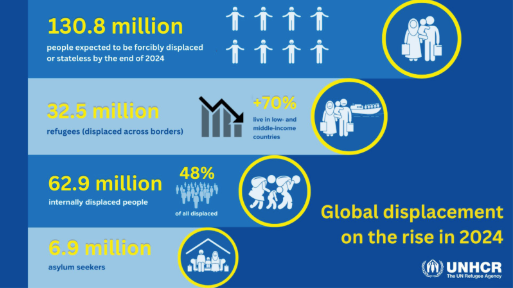
Within these figures, EU countries, above all Germany and the Netherlands, are important destinations because of their prosperity and living conditions. Such large migration movements create economic and social pressures in both countries of origin and destination, increasing the importance of international cooperation, migration experts and advisers.
Migration Trends in Europe
In recent years, European Union countries have been a major destination for both regular migrants and asylum seekers. In 2023, EU countries issued a total of 3.7 million first residence permits to non-EU citizens. This represents an increase of 4.7% compared with 2022 and the highest annual figure since data collection began in 2013.
In 2024, however, the number of first residence permits issued by the EU fell by 8.3% to around 3.5 million. The sharpest drop was in employment-related permits (12.2%). Looking at how the 2023 permits were distributed, the reasons migrants come to Europe can be listed as follows:
1. Work- and Employment-Based Migration
33.8% of the permits issued in 2023 (about 1.3 million) were for employment. European economies attract large numbers of foreign workers to fill their own labour shortages. Demand for skilled people is particularly high in sectors such as information technology, engineering and health. For example, most people coming to the EU from countries such as India, Ukraine, Belarus and Turkey received work-related visas.

2. Family Reunification-Based Migration
26.4% of all permits were for family reunification (bringing a spouse, children or parents). In this category, Moroccan nationals rank at the top. In Europe, Moroccan and Turkish migrants are among the groups that most often receive residence permits through family reunification. Naturally, this category grows as migrants who came earlier for work or asylum bring their families.
3. International Protection
25.6% of permits fell under humanitarian and other reasons. This heading covers international protection cases such as asylum and refugee admission. The humanitarian category also grew from 2022 to 2023 (+5.3%). In 2023 the groups receiving the most humanitarian residence permits in Europe included Belarusians (148,957), Syrians (127,043), Afghans (97,339) and Ukrainians (53,186). These figures show how regional developments such as the Ukraine crisis and political repression in Belarus are reflected in Europe. From Turkey, people seek asylum in Europe on grounds such as religious belief, membership of a particular social group, ethnic origin or sexual orientation.
4. Education-Based Migration
14.3% of permits were for education. Although this share may seem small, the education category showed the largest increase in 2023 (+13.5%). European universities attract students from all over the world. Nationals of India (38,157 students), China (35,620) and the United States (26,821) in particular benefited most from education permits in Europe. Europe’s high-quality higher education institutions and research opportunities keep the inflow of students steady.
Asylum Trends in Europe
Irregular migration and asylum applications are also an important part of Europe’s agenda and deserve separate treatment. In 2023, 1.14 million asylum applications were lodged in EU+ countries, the highest level since the 2015–2016 refugee crisis.
Today, migration management across Europe is at the centre of political debate; while rising far-right parties harden their anti-migration rhetoric, centrist parties try to develop more balanced policies that support controlled migration. Although countries such as Germany and the Netherlands need skilled migration because of labour shortages, public polarisation over asylum and irregular migration has become clearly visible. While solidarity and burden-sharing within the EU often lead to crises, border countries on the migration routes such as Greece, Italy and Spain are under pressure from high numbers of applications.
In recent years these developments have led to a decline in asylum applications to EU+ countries: in 2024, 1.01 million applications were received, a decrease of 11% compared with the previous year. In 2025, applications fell by 19% to around 822,000, and in the first half of 2026 to around 332,000. Despite this decline, Afghans, Venezuelans, Syrians and Turkish nationals continued to rank among the top applicants.
The rising number of asylum seekers reopened debate on the shortcomings of the existing asylum rules within the EU known as the Dublin system (responsibility of the country of first entry). Indeed, in the 2015 crisis, applications piling up in countries such as Greece and Italy created tension with other members.
To address this, EU countries negotiated a new Pact on Migration and Asylum for a long time, reached agreement on the key issues in December 2023, adopted the Pact in May 2024, and it has applied since 12 June 2026. The new rules aim at a fairer distribution of asylum seekers among member states and faster border procedures. Under the new solidarity mechanism, for example, every member state must take part in solidarity, but it can do so by accepting asylum seekers, by making financial contributions or by providing operational support.
In conclusion, anyone interested in migration movements originating in Turkey and heading for Europe needs to know these tendencies and trends and be able to make use of the power of the figures.
Sources
- IOM – World Migration Report worldmigrationreport.iom.int
- UNHCR – Global Trends unhcr.org
- Eurostat – Residence permits ec.europa.eu
The views expressed in this article are the author’s own and do not necessarily reflect PUGAT’s institutional position. Editorial Principles
Monthly · free
Compass of the Month
PUGAT’s monthly newsletter.
Read next



What is PUGAT? A non-profit community publishing independent analysis from Europe on security, migration and society in Turkish, German and English.
Go to the homepage