
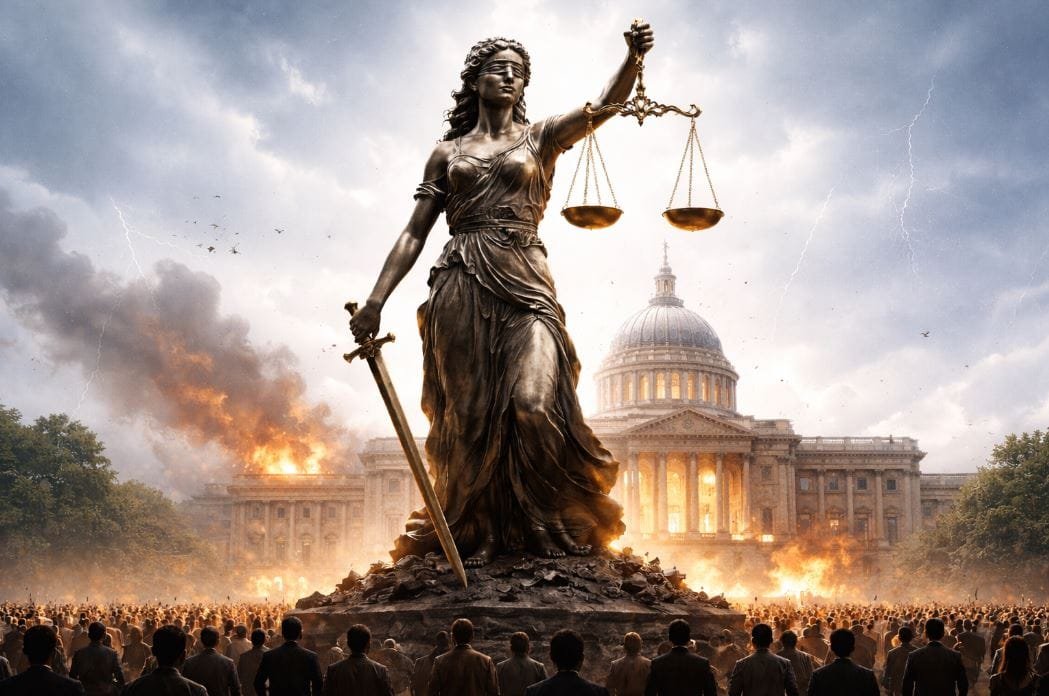
Plato’s Republic and Nizam al-Mulk’s Siyasatnama ask the same question: How long can order survive without justice? Power that grows through extraordinary powers does not strengthen the state; it inflates it like a balloon ready to burst.
A political paradox stretching from Plato to Nizam al-Mulk, and the fragile balance of today
Some words, once spoken, open every door of history. Justice is one of them. When people begin to talk about justice, they are in fact beginning to talk about the state, order, fear, hope and even their own conscience. Because what we call justice is not merely a court ruling or a motto decorating the walls of courtrooms. Justice is a society’s “inner voice”, a state’s “heartbeat”, the “social contract” between society and the government or state.
Plato’s Republic and Nizam al-Mulk’s Siyasatnama, although separated by centuries and by civilisation, ask the same question in different languages and in the context of different social dynamics:
Does the state exist for justice, or for political order? And, more provocatively: How long can order survive without justice?
The answers to these questions still burn our tongues today. Because the greatest problem of our time is often less a debate about “good governance” than a debate about “abused power”. If the politician at the very top of a country (whether called president, head of state or anything else) normalises injustice, corruption and discrimination, uses crises as a pretext to issue emergency decrees with extraordinary powers, detains people unjustly, arbitrarily removes them from public office and narrows the free space of social media, then Plato’s philosophy and Nizam al-Mulk’s experience meet at the same point: The state grows relatively stronger, but it does not grow; it swells like a balloon ready to burst.
Two Texts, Two Definitions of Justice
Plato thinks of justice as a kind of harmony. For him, justice means every part of society staying in its own place; government with its reason, defence with its courage and production with its labour forming a whole. When justice breaks down, it is not only that “someone is wronged”; the soul and the institutions of the state crack. For Plato, injustice is the sibling of disorder and chaos. When people begin to put power in place of rules, closeness in place of merit and interest in place of truth, the seeds of rot have been sown from within, even if the city or country appears to stand.
Nizam al-Mulk, by contrast, describes justice with a harsher, more naked realism. Preventing oppression, stopping injustice, supervising officials, protecting the rights of the people… In his work, the Siyasatnama, justice is not a “feeling” but a “mechanism”. Because a state survives not on good intentions alone but on a functioning system. If oversight weakens, justice becomes mere talk. Talk multiplies, rights diminish, and the arbitrary decisions some people make and the laws they pass restrict society’s freedoms.
Today, these two approaches mean this: Justice is both a moral compass and an institutional locking system. If the compass breaks, direction is lost; if the lock breaks, the door swings wide open. The laws that are made are then perceived not as justice but as arbitrary practice.
The Political Paradox: Power for Justice, Limits for Power
It is a fact that government needs power. But power, once tasted, does not easily go on a “diet”. Today it is said that “there is a crisis”; tomorrow, even when the crisis is over, the extraordinary powers remain. Because power, more often than managing the crisis, builds itself a new throne within it. It turns into an effort to secure a sustainable existence in line with its own interests.
This is the reality of the political paradox:
• Justice requires order.
• Order requires power.
• If oversight weakens as power grows, justice disappears. And when justice disappears, order turns into a regime of oppression.
Seen from outside, oppression and a sense of injustice can create a silent calm. You know how children sometimes go quiet when there are guests in the house… and then all hell breaks loose once the guests leave. Societies are like that too; under pressure the silence grows, but that silence is often not peace but social pressure building up, ready to explode at the ballot box.
Injustice + Corruption + Discrimination: The Unilateral Shelving of the Social Contract
Injustice prevents people from seeing the state as a “referee”. Especially when state institutions tied to the government take sides, citizens take sides too. Discrimination divides society into “us and the others”. This division poisons not only politics but even neighbourliness, the workplace and the schoolyard. Corruption is a different wound altogether. If the state’s resources are used not for the “common good” but for the interests of certain circles, that is, for partisans, a single sentence settles in the citizen’s mind: “This order is not for me.”
That sentence is the most expensive sentence a country can have. Because people move from “belonging” to “distance” in their relationship with the government or state. Public order seems to grow stronger on paper, but social bonds slowly begin to come apart from within. In Plato’s language, harmony is lost. In Nizam al-Mulk’s language, legitimacy melts away.
The Abuse of Extraordinary Powers in Crisis: The Breaking of the Scales of Justice
In times of crisis, decisions must be taken quickly; that is true. But if extraordinary powers are not, in turn, limited by law, government slides from “solving the crisis” to “expanding its power by managing the crisis”. Sweeping purges by emergency decree, arbitrary arrests, the weakening of the right of defence, mass dismissals from public office… these destroy not only one area of justice but the very sense of justice.
And when the sense of justice collapses for everyone over time, society’s reaction does not take a single form; it comes in waves:
The First Wave: Silence and Self-Censorship
People speak less and present their views in public less. The reflex of “let me not get into trouble” grows. When everyone’s tongue is shortened, the issue is not that people have “no opinions” but that they are “counting the cost”. The fear begins: Who will look after my family if something happens to me, and will I lose the comfort zone I have?
The Second Wave: Polarisation and the Erosion of Trust
One side defends what is done in the name of “order”, the other says “the rule of law is gone”. The common language weakens. Everyone begins to see one another not as “fellow citizens” but as a “threat”. This wears society down from within. Society’s energy melts away in rally squares. People are drawn into running each other down, looking for each other’s faults and the partisanship of “my political party”.
The Third Wave: The Displacement of Reactions
If the squares are closed, reaction grows somewhere other than the street. In banned social media accounts, humour, whispers, the diaspora, calling to account at the ballot box, boycotts, passive resistance, brain drain and even leaving the country.
A person who cannot speak does not fall silent; they simply find another language. Sometimes this is irony, sometimes a silent migration and sometimes the heaviest way of saying “I am no longer here”.
It should not be forgotten that oppression does not always destroy reaction. More often, it changes the form of reaction. Society is like water: if you close one channel, it bursts out somewhere else. And the more leaks there are, the harder they become to repair with each passing day, until they grow uncontrollable.
Restricting Social Media: A Silence That Magnifies Mistakes
Social media is the public square of the modern age, where individuals express themselves and can say “I”. Of course, realities such as calls to violence, targeting and hate speech are absolutely unacceptable there. But restricting the free space entirely under the pretext of “security” often turns into an escape from criticism. Because when free space shrinks, mistakes do not decrease; they merely become invisible.
Plato says that a state cannot grow wise without wisdom and debate. Nizam al-Mulk knows that justice cannot work where complaints are not heard. Restricting social media may therefore bring “comfort” in the short term, but in the long term it weakens the state’s ability to correct its own mistakes.
So if the leader persists on this course, where does social reaction lead?
There is no single answer to this question. But the shared logic of the two texts gives us a “direction”: If justice retreats, the power of the state seems to grow, but the rope binding society to the state grows thinner. And once that rope thins, at some point the following happens:
- Society sees the government or state not as “common ground” but as a “risk zone”.
- Young people look for their future elsewhere.
- Institutions are staffed on the basis of loyalty rather than merit.
- The economy shies away from uncertainty and injustice.
- A chronic tension sets in across society, and although not everyone can say that something is “going wrong”, it is felt down to the capillaries.
If, in this process, those holding the reins of government try to respond to society with more “repressive control”, the paradox deepens. As control increases, the language of objection changes; as the language of objection changes, the government grows more afraid; and the more afraid it grows, the more control it wants. Thus the vicious circle begins.
Will Power Be the Servant of Justice, or Its Master?
The city or country of Plato’s dreams is an order in which justice is united with reason. Nizam al-Mulk’s experience tells us that justice lives through oversight. Where the two meet today, we can say this:
When power is the servant of justice, it keeps the state standing. When justice is the servant of power, the state pretends to stand, but it begins to rot from within.
Societies live not by law alone but by the belief that justice exists. When that belief is lost, the state falls out of the people’s hearts, even if it grips all the tools in its hands more tightly. And a state that has fallen out of people’s hearts may one day be surprised to ask, “Why have I been left so alone?”
Once the sense of justice is broken in a person’s heart, repairing it is harder than repairing a building. Because a building is made of bricks, but trust is made of lived memories. And you cannot fix a memory with a hammer.
In conclusion, if the executive power or government that runs the state forgets that its office is a “trust” given to it by the people, it also loses its sense of justice. When it begins to run the state and the people as if they were an inheritance from its father, like a family business, deep chasms begin to open between the people’s demand to be governed and the government’s desire to rule.
What is lost are generations, the economic prosperity of the people and the dream of becoming a modern state.
And this trauma, whose duration we cannot foresee, will be taught in classrooms as an unfortunate case in the pages of history.
Sources
- Plato, The Republic
- Nizam al-Mulk, Siyasatnama
The views expressed in this article are the author’s own and do not necessarily reflect PUGAT’s institutional position. Editorial Principles
Monthly · free
Compass of the Month
PUGAT’s monthly newsletter.
Read next



What is PUGAT? A non-profit community publishing independent analysis from Europe on security, migration and society in Turkish, German and English.
Go to the homepage