

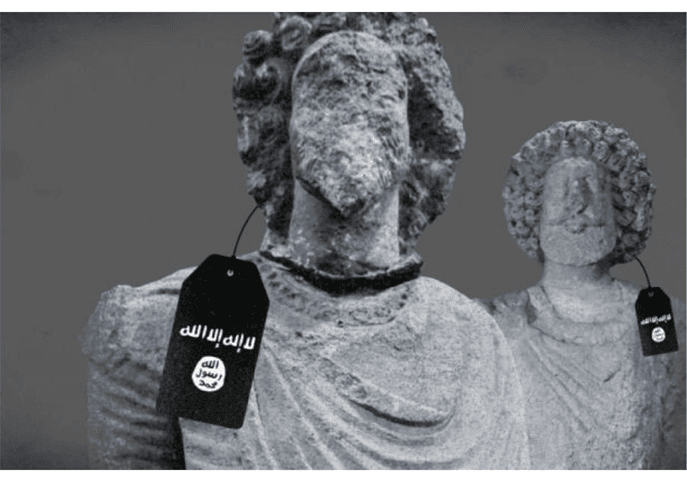
For ISIS, which plundered Palmyra, antiquities smuggling was one of its most important sources of income after oil. It was repeatedly alleged that Turkey was one of the markets where these artefacts were laundered.
Turkey–Syria Criminal Links | 6
Antiquities smuggling has been on the agenda ever since the Assad government began to falter in Syria and lost control of many areas. As we all know, ISIS, after seizing ancient cities in Syria, openly attacked historical artefacts. The footage was handed to the press for propaganda purposes and used for various ends. Yet behind the scenes, one of the organisation’s leading sources of income was antiquities smuggling. International media repeatedly alleged that, after oil sales, artefacts looted in Syria were one of the sources financing terrorist activity, and that Turkey was one of the markets where these artefacts were laundered.
In her article titled “ISIS and Antiquities Smuggling”, Aylin Seçkin summarises the situation that emerged after the power vacuum in Syria as follows:
“After ISIS overran Palmyra in Syria, a UNESCO World Heritage site, archaeologists around the world held their breath, waiting to see what would happen to the historic site. Antiquities smuggling, which looked like a simple story of opportunism, had evolved in the Syrian context into an organised international criminal enterprise financing terrorism.
According to information released by American sources, the organisation earned tens of millions of dollars from the sale of wall mosaics and icons from the al-Nabek area of Syria alone, and the quantity of antiquities imported from Syria into the US is considerable. The value of undeclared objects is said to be far higher still. Although it is impossible to establish the total value of this trade precisely, American sources estimated it at around 100 million dollars a year. ISIS’s turn to this route to generate income was the main reason behind these figures.
While small pieces found local buyers in the Turkish and Lebanese markets, large pieces were delivered to buyers and collectors in the West, especially Switzerland, as well as China and the Gulf states. Many people, including journalists, witnessed Roman-era vases stolen from graves being sold openly in boxes in the Gaziantep bazaar. For instance, Harun Unvar, owner of an antiques shop in Gaziantep’s historic bazaar, told a reporter in an interview that he had turned away a man who came to his shop wanting to sell him a marble bird figure for 220 dollars, and that while Syrian refugees tried to sell smaller, less valuable pieces, the larger pieces were stolen and sold secretly for very large sums.
Willy Bruggeman, former head of Europol and new chairman of the Belgian Federal Police Council, spoke of how ISIS secretly organised these sales through social media across a very wide network, bypassing the classic sales channels and thus making it impossible to trace them. In fact, it was said that although Facebook had taken the necessary measures, photographs of the objects were shared through private messages, WhatsApp, Skype and SMS, and sales at very high prices took place worldwide.
Knowing that the historical artefacts of the territories they had seized were valuable, ISIS militants controlled this traffic and built their sales networks with very subtle methods. One of the key points of this trade was the city of Manbij, where ISIS even had an official office set up to support and tax these activities.
However, it is thought that not only ISIS but also the Assad government is responsible for the plundering of antiquities. Soldiers of Assad’s army can also be seen in some videos uploaded to YouTube stealing reliefs from historic tombs in Palmyra. On 12 February 2015, in Resolution 2199, the UN Security Council decided that trade in cultural property illegally removed from Syria since 15 March 2011 must be prevented.
The fact that these sales directly support terrorism requires governments to approach the issue with greater sensitivity. ISIS was thought to have set up a team of intermediaries dealing in antiquities and to have provided armed security escorts for dealers travelling to the Turkish border for the antiquities trade. ISIS, which seized a large number of heritage sites in Iraq and Syria, had a ministry regulating the “trade in artefacts” that granted smugglers special permits in return for money (tax).”
Of course, it was inevitable that new power groups and gang-like structures would emerge over time in the areas vacated by ISIS.
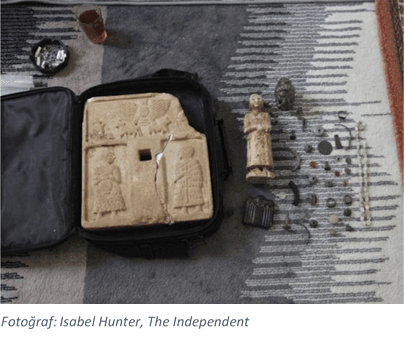
Meanwhile, an investigation by The Independent revealed that the city of Gaziantep had become the hub of smuggling in the region and showed the income terrorist groups earned in this way. Posing as a buyer, Independent reporter Isabel Hunter met antiquities smugglers in a flat in Gaziantep, which she described as “the main centre for antiquities deals”. In her report Hunter described how a smuggler code-named Hani pulled a 4,000-year-old limestone tablet covered in hieroglyphs out of his laptop bag as if it were an ordinary item. Hunter added that while most of the smugglers were Turkish, Hani was Syrian, and that they did not hesitate to display the “treasures” in their hands so that she could report back to “her boss in London”. Hunter was also shown photographs of 13th-century Christian manuscripts and a book containing Freemasonic iconography. According to two of the smugglers, the manuscripts are now in Germany.
To reduce their risks, the smugglers had loaded their catalogues onto their mobile phones and said: “We will find you whatever you want. Just look at the pictures and tell us what you want.” In the pictures Hunter saw leather-bound manuscripts, Aramaic and Greek documents, objects bearing the Star of David and ancient Egyptian perfumes said to have aphrodisiac properties. Another smuggler who joined them, named Tarık, showed an Athenian coin which he claimed was one of only 30 in the world and on which he put a price of 300,000 dollars.
Michael Danti of the Syrian Heritage Initiative (SHI), supported by the US State Department and the American Schools of Oriental Research, says that once the artefacts are brought into Turkey they are shipped out from Mersin, Antalya or İzmir. Danti states that the fake documentation for items shipped via Cyprus is produced in Italy, Greece and Portugal. While UNESCO has described the plundering of Syria’s historical heritage as “cultural cleansing”, the efforts of cultural institutions and Interpol are not proving effective. In 2014, various raids were carried out in our southern border provinces as part of the fight against smuggling, and the Roman-era artefacts seized were placed under protection in museums in Gaziantep, Urfa, Hatay and Mardin.
Coming to the present day, we see that the issue has not yet lost its urgency. The Russian Ministry of Defence alleged that armed groups backed by Turkey were smuggling antiquities in Syria’s Afrin region. It was stated that the artefacts were being smuggled to be brought into Turkey and sold on the black market. And this allegation came at a time when Putin and Erdoğan met frequently and displayed friendly attitudes towards each other. Since neither leader has a journalist in his own country who would ask about this (or rather, since those likely to ask are not allowed near them), we cannot know exactly how the leaders view the matter.
Oleg Egorov, deputy head of the Russian Reconciliation Centre, claimed that “Turkish-backed groups are carrying out archaeological excavations near the city of Afrin, using modern heavy equipment and explosives, to search for architectural and historical artefacts and antiquities”. According to the Syrian state agency SANA, Egorov said that these groups were “causing serious damage to Syria’s cultural heritage sites”. It is worth noting that this allegation dates from September 2022.
*****
Sonuç
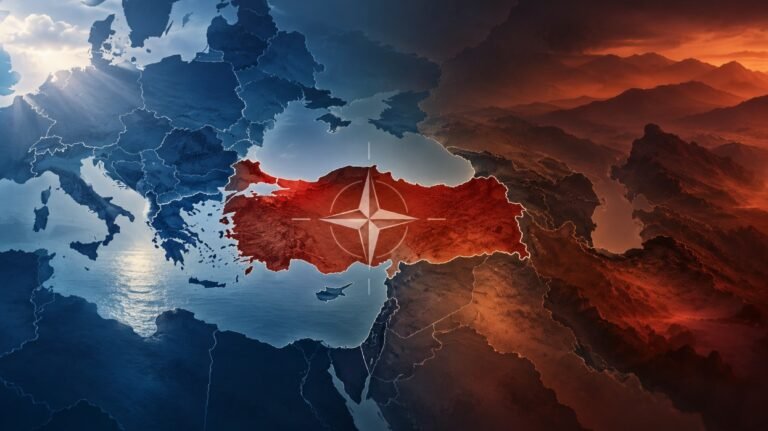
In conclusion, it is worth stating that Turkey has come to be seen by the modern world not, as it once was, as a buffer zone between unstable regions and Europe that strove to solve its problems, and at the same time a great and promising potential, but as a part of the troubled region itself.
Just as a group in power destroyed the hope of EU membership with its own hands in line with its own interests, it has even made NATO membership a matter of debate. When we look at where things stand in terms of border control and security, the situation is so grave that even the world’s leading news agencies are running stories about young people from countries such as Iraq and Syria who want to join terrorist organisations gathering at the Istanbul bus station, organising themselves and setting off for the regions they are aiming for. Nobody seems to have any doubts about crossing the border illegally anyway. But these are the natural result of the politicisation of the police and the army and of the drift away from the norms of democracy and the rule of law.
Put simply, the situation that has emerged is in fact the natural result of Turkish realities everyone knows: hyperinflation, excessive taxes, the drift away from the rule of law, poverty, social injustice, propaganda, the ruling power’s insatiable greed for enrichment, the ineffectiveness of the opposition, the deep state mechanism’s reach into every field, brain drain, bribery and corruption. What the public sees is merely the tip of the iceberg. Behind it, sadly, lie terrible suffering, poverty, lost lives, nameless graves and countless people living lives more wretched than those of slaves.
Sources
- UNESCO – Syria’s cultural heritage en.unesco.org
- Aylin Seçkin, “IŞİD ve Tarihi Eser Kaçakçılığı”
The views expressed in this article are the author’s own and do not necessarily reflect PUGAT’s institutional position. Editorial Principles
Monthly · free
Compass of the Month
PUGAT’s monthly newsletter.
Read next


What is PUGAT? A non-profit community publishing independent analysis from Europe on security, migration and society in Turkish, German and English.
Go to the homepage