
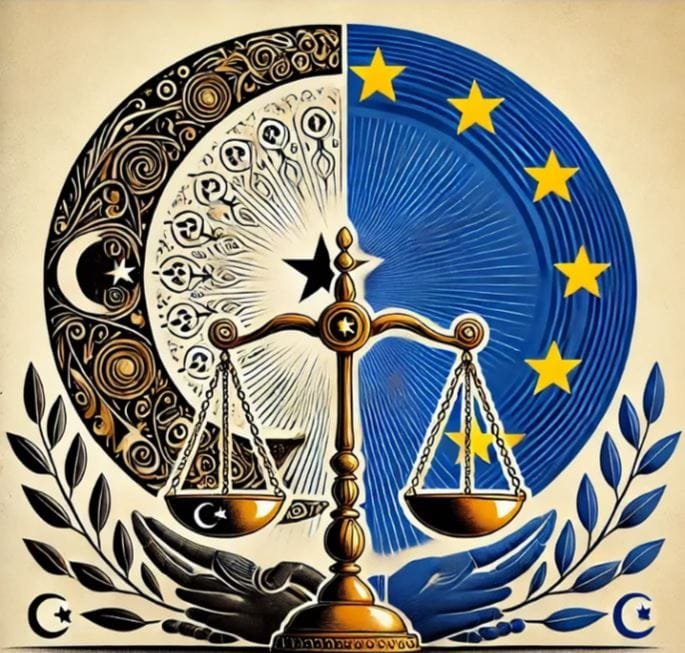
Turkey and the EU are like two lovers who can never be united. Turkey has drifted away from the membership process, the rule of law has declined and it has moved closer to Russia. Even so, the author argues, the EU should not give up on Turkey.
The relationship between Turkey and the European Union can be compared to the story of two lovers who can never be united. Like a bad song, this relationship sometimes speeds up and sometimes slows down. The fact that the parties come from different languages, religions, geographies and cultures makes the relationship difficult.
The Historical Process
According to official data, Turkey’s EU membership process began in 1963, when Turkey signed an association agreement with the European Economic Community, and gained momentum in 1987 when it applied for full membership. Accepted as a candidate by the EU members in 1999, Turkey began full membership negotiations in 2005. (i) However, Turkey’s goal of becoming a full member of the European Union has still not been achieved.
The Importance of Turkey
Today Turkey is struggling with many problems, above all in security and the economy. Despite this, Turkey remains an important military power in its region. In 2022 Turkey invoked the Montreux Convention and restricted the passage of Russian warships from the Mediterranean to the Black Sea.(i) Turkey’s character as a bridge between Europe and the Middle East and its direct access to the Black Sea make it a central figure in tackling crises and conflicts in the region.(a)
A Turkey in Decline
Looking at Turkey–EU relations over the last ten years, we see that Turkey has moved considerably away from the membership process. According to the European Commission’s reports, Turkey’s position on the Common Foreign and Security Policy has been diverging increasingly from the European Union since 2011; while the alignment rate fell to 10% in 2023, it was 97% in 2007. (i)
The European Commission does not consider Turkey adequate in terms of the rule of law, human rights and fundamental freedoms. Indeed, in a country where about 5% of the population has been subject to a terrorism investigation, one cannot speak of the rule of law and democracy.(i)
Turkish–Russian Rapprochement
Moreover, in the Russia–Ukraine war, instead of taking a stance against Russia like all European countries, Turkey has maintained its economic, political and military partnerships with Russia. This causes unease among European countries. The European Union’s political disappointment on this matter was clearly expressed in the European Council’s statement of December 2022; while it noted that Turkey retains its EU candidate status, it also stressed the unease caused by Turkey’s failure to comply with the sanctions imposed on Russia.(a)
Refugees and Turkey
Turkey’s refugee policy also troubles the European Union. The European Union expects Turkey to guard its borders well. However, the Turkish government has left its southern borders uncontrolled since the beginning of the Syrian crisis. Among the millions of people who crossed the borders were criminals and terrorists. Unfortunately, by persuading the Erdoğan government with money, the European Union has in effect made Turkey the country hosting the most refugees in the world.(i) The Erdoğan government continues to use refugees as a means of blackmail to extract money from the European Union.(i)
Doors Closing on Turkey
Another problem is the European Union’s current visa policy towards Turkey. This policy significantly restricts the economic freedom of Turkish businesspeople, causing many potential trade opportunities to be lost and preventing cultural interaction with the West.
Turkey Cannot Be Left to Its Fate
Recent events and refugee flows have once again shown that the tensions between Turkey and the European Union must be brought to an end.
Turkey has long been calling for a comprehensive modernisation and expansion of the existing customs union with the European Union, but the Turkish government is not fulfilling its obligations on many issues, such as improving the rule of law and democracy.
The European Union, for its part, has so far behaved like a teacher who holds back a failing pupil instead of looking for ways to help them improve. These attitudes have not only harmed the people of Turkey; in a world that globalisation has turned into a small village, they have exposed all people to the consequences of wrong decisions.
Fire Does Not Burn Only Where It Falls
It has become clear that a Turkey excluded by the European Union has, through some of its leaders, not only strengthened its relations with Russia and China but also engaged with radical groups in the region. Many states now understand much better the negative effects of this situation both regionally and globally.
Turkey’s relations with Russia, its military interventions in Syria and its links with radical terrorist groups are making relations between Turkey and the European Union even more difficult. In the short term there seems to be no realistic hope of Turkish EU membership.
In this context, Turkey’s current foreign policy and international relations create obstacles to EU membership. However, Turkey’s potential to increase cooperation with the EU in other areas remains.
New Cooperation, New Hopes
For these reasons, it seems more reasonable from the EU’s perspective to shift relations towards a new policy direction beyond the formal membership process. More and closer cooperation could be considered in areas such as democracy, law, security, defence, migration, the economy and visa policy.
As a first step, easing visa requirements could be the wisest move. This step would both allow trade relations to begin between Turkish businesspeople and European companies and create an opportunity for strong ties between the people of Turkey and Europe. In this way the economy’s decline could be halted and, at the same time, the awareness of the people of Turkey on democracy, law and human rights could be raised indirectly. Citizens will naturally demand in their own country the positive values they see in Europe. This will speed up efforts to make Turkey a better and more civilised country.
In conclusion, to prevent Turkey from drifting even further away from Europe, the rule of law and democracy, and to prevent the country from being thrown into the fire by leaders who have succumbed to their ambitions, a perspective of structured partnership with the European Union should be developed. The European Union should build sustainable partnerships with Turkey that can be developed further, in spite of its authoritarian leaders. Otherwise, this fire could burn not only Turkey but everyone.
Sources
- Roger Näbig, „Die Türkei als sicherheitspolitischer Partner der Europäischen Union“, Europäische Sicherheit & Technik, 7/2024, p. 21.
- European Commission – Türkiye Reports enlargement.ec.europa.eu
- Republic of Türkiye, Ministry of Foreign Affairs – Directorate for EU Affairs ab.gov.tr
The views expressed in this article are the author’s own and do not necessarily reflect PUGAT’s institutional position. Editorial Principles
Monthly · free
Compass of the Month
PUGAT’s monthly newsletter.
Read next



What is PUGAT? A non-profit community publishing independent analysis from Europe on security, migration and society in Turkish, German and English.
Go to the homepage